










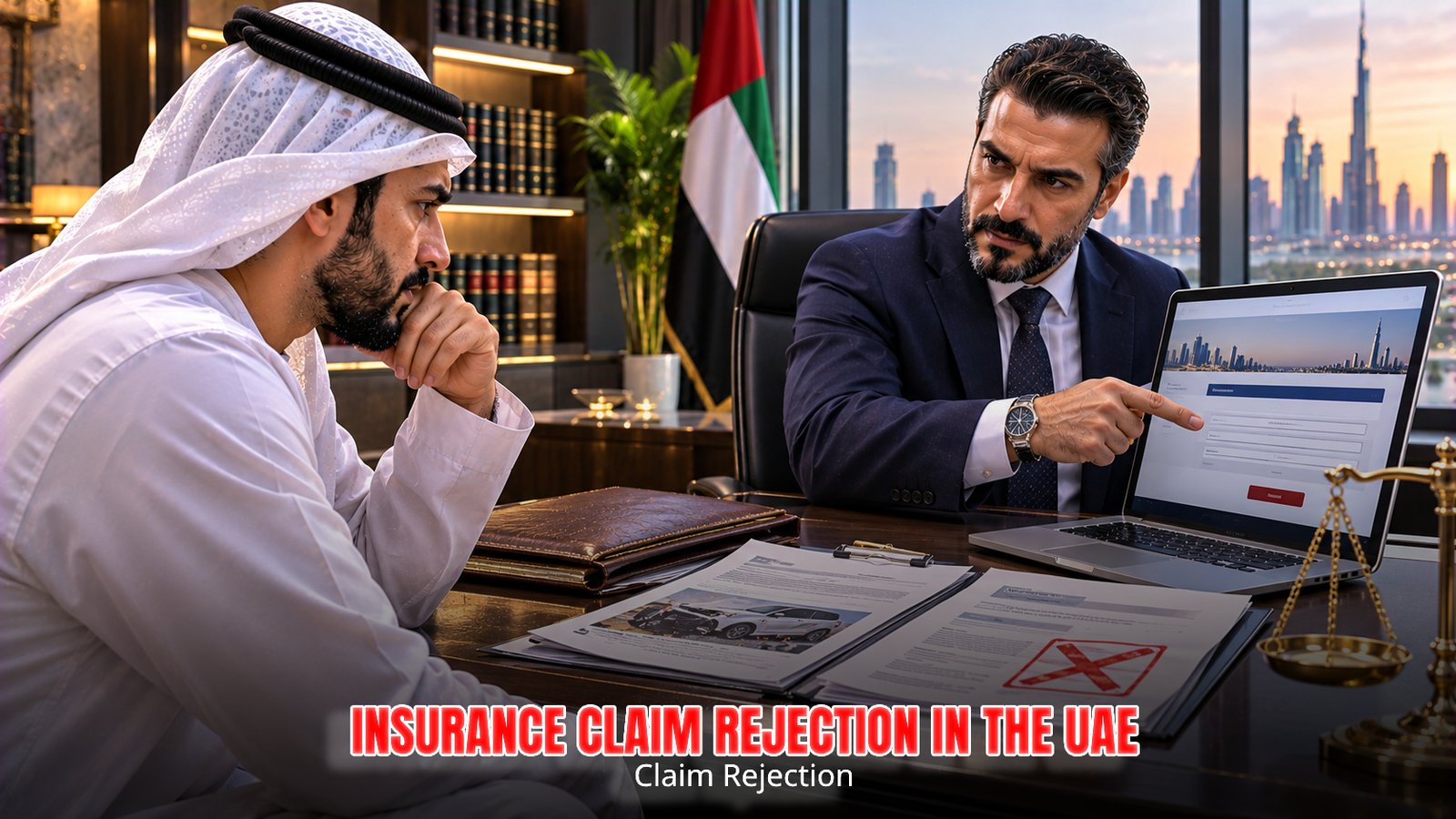
A vehicle owner, property owner or business in the UAE may suffer financial damage as a result of an explosion, falling debris, fire or security-related incident, only to have their insurance claim rejected on the grounds that the incident was connected to war, hostile acts or force majeure.
The situation can become particularly difficult when the affected person holds a comprehensive insurance policy and believes that it protects against all types of damage, only to discover that contractual exclusions may remove certain risks from the scope of cover.
But can an insurance company legally reject a claim simply because the incident is connected to war-related circumstances? Can the policyholder challenge the rejection? What rights are available under UAE law? And how can a complaint be submitted against an insurance company through the Sanadak platform?
In this guide, Legal Consultant Mohammed Jasem explains the legal framework governing insurance claims in the UAE, the circumstances in which a rejection may be challenged, and the practical steps policyholders can take to protect their rights based on the policy wording, the facts and the available evidence.

1. Can an Insurance Company Reject a Claim Because of War in the UAE?
An insurance company may be entitled to reject a claim if it establishes that the damage resulted from a risk expressly excluded from the insurance cover, such as war, invasion, hostile acts or war operations, depending on the wording of the policy and the type of insurance.
However, the existence of an exclusion in an insurance policy does not automatically make every rejection decision valid. The insurer must assess whether the exclusion actually applies to the incident and whether its reliance on that exclusion is consistent with the applicable legal and regulatory requirements.
When reviewing an insurance claim rejection, several important factors should be considered:
- The nature of the damage and whether it resulted from an ordinary accident, a war-related act or another excluded risk.
- The wording of the insurance policy, including its general and special terms and any additional endorsements.
- Whether the exclusion relied upon by the insurer is clearly expressed.
- The connection between the actual cause of the damage and the exclusion in the policy.
- Official documents, police reports and technical inspection reports.
- Whether additional cover was purchased for the risk that caused the damage.
Therefore, challenging an insurance company’s rejection should be based on contractual grounds, legal arguments and supporting evidence—not merely on the fact that the policyholder has comprehensive insurance.
2. What Is the Position of UAE Law on War Exclusions in Insurance Policies?
Insurance companies operating in the UAE are subject to federal legislation and the regulatory decisions, standards and requirements issued by the Central Bank of the UAE. These rules govern insurance activities, policy conditions, coverage exclusions and insurers’ obligations towards policyholders.
One of the key legislative developments to consider when examining insurance disputes is Federal Decree-Law No. 6 of 2025 concerning the Central Bank of the UAE, the Regulation of Financial Institutions and Activities, and Insurance Business, which entered into force on 16 September 2025.
Article 185 repealed Federal Decree-Law No. 48 of 2023 concerning the Regulation of Insurance Activities. Article 183 provides for the continued application of existing regulations, decisions, standards and circulars until they are replaced, to the extent that they do not conflict with the new legislation.
These transitional provisions make it important to distinguish between legislative provisions that have been repealed and earlier regulatory instruments that continue to apply under the transitional arrangements.
When reviewing an exclusion or limitation of liability in an insurance policy, attention should also be paid to the applicable disclosure requirements, the clarity of the relevant terms, and the manner in which they were incorporated and approved under the regulations in force.
It should not be assumed that every war exclusion is invalid simply because it appears in small print or is printed in a colour similar to the rest of the policy. The relevant regulatory requirements, the date on which the policy was issued and the wording of the disputed clause must all be examined.
For this reason, the complete insurance policy should be reviewed before accepting a rejection decision or taking legal action against the insurer.
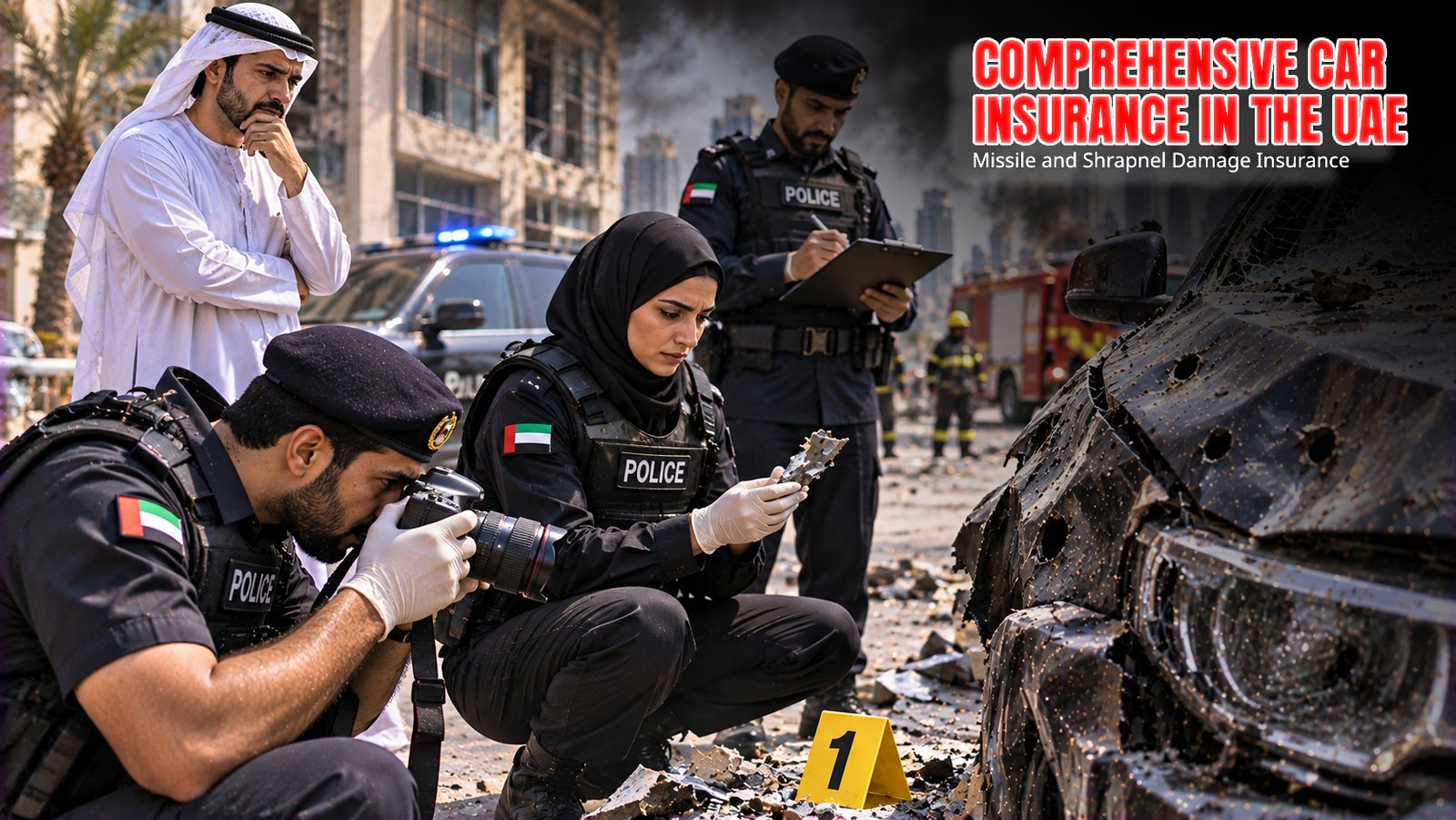
3. Does Comprehensive Motor Insurance Cover Damage Caused by Missiles, Shrapnel or Explosions?
Some vehicle owners believe that comprehensive motor insurance covers every type of damage to their vehicles. This assumption is not always correct.
Comprehensive insurance generally provides broader protection than third-party liability insurance. Nevertheless, the scope of cover remains subject to the terms, conditions and exclusions stated in the policy.
The UAE Unified Motor Vehicle Insurance Policy Against Loss and Damage contains exclusions relating to invasion, foreign hostile acts and war operations, whether war has been declared or not. It also addresses civil war, civil disturbances and certain other risks.
The potential insurance position for different types of damage may be assessed as follows:
| Type of damage | Insurance position |
|---|---|
| Military shrapnel falling on a vehicle | Subject to review of war and hostile-act exclusions |
| Vehicle damage caused by an explosion | Depends on the cause of the explosion and the policy terms |
| Fire resulting from an accidental incident | Subject to fire cover and applicable exclusions |
| Damage resulting from riots | Civil disturbance exclusions must be reviewed |
| Terrorism-related damage | Depends on the policy definitions, exclusions and any additional cover |
| Accidental damage unrelated to an excluded risk | Assessed according to the scope of insurance cover |
It is important not to confuse third-party motor liability insurance with comprehensive insurance against loss and damage. Each has its own coverage provisions and exclusions.
Similarly, damage caused by riots or civil disturbances should not automatically be treated as covered, since some standard motor insurance policies expressly exclude these risks.
4. Why Is a Police Report Important When Claiming Insurance Compensation?
A police report is one of the most important documents that may support an insurance claim, particularly where there is disagreement about the cause of the damage.
For example, a vehicle may be damaged by a nearby explosion, a falling unidentified object or a fire in an area that has experienced security incidents. In such circumstances, the insurance company may request an official report to establish the circumstances of the incident.
Official and technical reports can help clarify the nature of the incident. However, they do not, by themselves, determine whether compensation is payable. The insurance policy, its coverage provisions and exclusions must also be considered.
The following documents should generally be prepared:
- A police report or report issued by the competent authority.
- Photographs and videos showing the damage and the location of the incident.
- A technical inspection report and an estimate of repair costs.
- A complete copy of the insurance policy, including its terms and conditions.
- Correspondence exchanged with the insurance company.
- The insurer’s written claim rejection, if one has been issued.
- Any technical reports identifying the source and cause of the damage.
The incident should be accurately described in all supporting documents. The policyholder must not attempt to alter the nature of the incident or influence the contents of official reports in order to obtain compensation.
5. Five Legal Grounds for Challenging an Insurance Claim Rejection
A claim rejection does not necessarily bring the policyholder’s right to challenge the decision to an end. The rejection can be reviewed to determine whether it is supported by the policy and applicable law.
The following are among the grounds that may support an objection:
1. The War Exclusion Does Not Apply to the Incident
An insurance company may rely on a war or hostile-act exclusion even though the reports and supporting documents indicate that the damage resulted from a different event that does not fall within the exclusion.
In such a case, the policyholder may request a reassessment of the claim based on the actual cause of the damage and the available technical evidence.
2. The Insurance Exclusion Is Unclear
If an exclusion clause is unclear or capable of more than one interpretation, its meaning should be examined in accordance with the applicable legal rules on contractual interpretation and the nature of the insurance relationship.
However, ambiguity should not automatically be treated as establishing entitlement to compensation. The wording, circumstances of the contract and the policy as a whole must be assessed.
3. Failure to Comply with Disclosure Requirements or Regulatory Conditions
It is important to verify whether the limitation or exclusion of liability was incorporated and approved in accordance with the applicable legal and regulatory requirements.
A valid ground for challenging the rejection may arise if mandatory requirements concerning the drafting, approval or disclosure of the relevant term were not satisfied.
4. Additional Coverage Was Not Taken into Account
An insurance policy may contain an additional endorsement extending cover to certain exceptional risks.
All endorsements should therefore be reviewed. It is not sufficient to examine only the general policy conditions before accepting the rejection of a claim.
5. The Insurer’s Reasons or Supporting Evidence Are Insufficient
If the rejection relies on a general description of the incident without identifying the applicable contractual clause or properly considering the submitted reports and documents, the policyholder may request a written explanation and a reassessment of the claim.
The strength of any objection ultimately depends on the evidence, policy documents and scope of cover. None of these grounds, on its own, guarantees that compensation will be awarded.
6. How to File a Complaint Against an Insurance Company in the UAE Through Sanadak
If an insurance company refuses to pay compensation and the dispute cannot be resolved directly, the policyholder may be able to approach Sanadak, the independent Ombudsman Unit for complaints and disputes involving financial institutions and insurance companies falling within the Central Bank’s jurisdiction.
The complaint process generally involves the following steps:
Step 1: Submit a Formal Complaint to the Insurance Company
The policyholder should first submit a written complaint to the insurance company. It should include:
- The insurance policy number.
- The claim reference number.
- Details of the incident.
- The reasons for challenging the rejection decision.
It is advisable to keep the complaint reference number and proof of the date on which the complaint was submitted.
Step 2: Request Written Reasons for the Rejection
Ask the insurer to explain why the claim was rejected, identify the specific policy clause on which it relies, and explain how that clause applies to the incident.
A written explanation can help identify the precise contractual issue and provide a clearer basis for challenging the decision.
Step 3: Wait for 15 Calendar Days
According to Sanadak’s published eligibility criteria, 15 calendar days must pass from the date on which the formal complaint was submitted to the insurance company.
The policyholder may generally proceed if no written response has been received within that period or if the response received is unsatisfactory, subject to the other eligibility requirements.
Step 4: Submit the Complaint Through the Sanadak Platform
A complaint may be submitted electronically through the official website:
https://www.sanadak.gov.ae/en/
Select the relevant insurance complaint category, complete the required information and attach the supporting documents.
Sanadak’s published eligibility conditions include requirements relating to the type of complainant, the prior complaint to the insurer and the waiting period. Among other restrictions, the same complaint must not already be pending before a court or be a duplicate complaint. The published criteria also identify eligible individual consumers, sole proprietorships and small and medium-sized enterprises.
The complainant should review the current eligibility requirements before submitting the application.
Step 5: Follow Up on the Complaint Outcome
Sanadak reviews the complaint and supporting documents and may request additional information from the complainant or the insurance company.
After examining the file, the parties are notified of the outcome in writing. Where appropriate, corrective action may be directed towards the relevant institution.
If the complainant is dissatisfied with the outcome, the available appeal procedures or referral to the competent Insurance Dispute Resolution Committee may be considered in accordance with the applicable system.
It is important to distinguish between the outcome of an initial complaint review and decisions issued by the competent dispute resolution committee. An initial complaint outcome should not automatically be treated as a final judgment or an enforceable instrument.
7. What Documents Can Strengthen an Insurance Compensation Claim?
Preparing a complete claim file becomes particularly important when the damage is connected to security incidents or hostile acts, because the cause of the damage may be disputed on both technical and legal grounds.
The following documents may help support the claim:
- The complete insurance policy, including its general and special conditions.
- Additional endorsements and agreed insurance extensions.
- The insurance company’s written rejection.
- A police report or report from the competent official authority.
- A technical inspection report identifying the cause of the damage.
- Photographs and videos showing the damage.
- Repair invoices or estimates of the cost of restoring the property.
- Proof that a formal complaint was submitted to the insurance company.
- Correspondence and responses received from the insurer.
The documents should be organised chronologically, with a clear explanation of the connection between the incident, the resulting damage and the insurance claim. This makes it easier to identify the disputed issues and assess the legal basis of the claim.
8. Can War-Risk and Political-Risk Coverage Be Added to an Insurance Policy?
Some insurance companies may offer additional cover for certain exceptional risks, depending on the type of insurance, the available product and the insurer’s acceptance of the risk.
Common terms used in this area include:
- War Risks Cover: Insurance cover for war-related risks.
- Political Violence Cover: Cover for political violence risks.
- Terrorism Cover: Cover for terrorism-related risks.
- Civil War Extension: An additional extension for civil war risks, subject to its terms.
These extensions are not automatically available under every motor, travel or property insurance policy.
Furthermore, purchasing additional cover does not necessarily mean that every type of damage is insured. The compensation limits, exclusions, policy period and specific conditions of each endorsement must be reviewed.
Owners of high-value property and businesses should therefore assess their insurance needs before a policy is issued or renewed.
9. How Can Legal Consultant Mohammed Jasem Help You Challenge an Insurance Claim Rejection?
Insurance disputes require a careful examination of the relationship between the policy wording and UAE legislation, particularly where the insurer relies on exclusions relating to war, hostile acts or force majeure.
The correct legal approach begins with reviewing the reasons for the rejection and determining whether the insurance company has applied the policy conditions correctly and whether evidence or documents support the policyholder’s position.
Legal assistance in these disputes may include:
- Reviewing the insurance policy, its terms and the exclusions it contains.
- Analysing the insurer’s rejection and assessing whether it is consistent with the contract and applicable law.
- Reviewing police reports, technical inspection reports and documents supporting the claim.
- Identifying the legal grounds that may be relied upon to challenge the rejection.
- Preparing complaints and legal submissions relating to the dispute.
- Providing legal support during the complaint process before Sanadak.
- Assessing the available legal options for claiming compensation based on the nature of the dispute.
If your insurance company has rejected your claim because of war or hostile acts, do not rush to accept the rejection before reviewing your policy and the insurer’s reasons.
You may contact Legal Consultant Mohammed Jasem to request a legal assessment of your insurance claim, review the relevant documents and identify appropriate steps to protect your rights under the laws applicable in the UAE.
Frequently Asked Questions About Insurance Claim Rejection in the UAE
1. Does Comprehensive Car Insurance Cover Missile or Shrapnel Damage in the UAE?
Not necessarily. The UAE Unified Motor Vehicle Insurance Policy Against Loss and Damage includes exclusions relating to invasion, foreign hostile acts and war operations. Whether compensation is payable depends on the policy wording, the nature of the incident and any additional cover agreed between the parties.
2. Can an Insurance Company Reject a Claim on the Grounds of Force Majeure?
An insurer may rely on force majeure or a contractual exclusion to reject a claim. However, the relevant legal and contractual requirements must be examined, including whether the damage was actually caused by an excluded event. Merely describing an incident as force majeure is not sufficient, by itself, to establish that the rejection is valid.
3. Is a War Exclusion Invalid if It Is Printed in Small Font?
A war exclusion is not automatically invalid simply because of its font size or colour. The applicable disclosure and regulatory approval requirements must be examined, together with the legislative changes affecting insurance regulation in the UAE since 2025.
4. How Can I File a Complaint Against an Insurance Company in the UAE?
Start by submitting a formal complaint to the insurance company. Wait for 15 calendar days. If no written response is received or the response is unsatisfactory, you may submit a complaint through Sanadak, provided that the eligibility requirements are satisfied.
5. Is Filing an Initial Complaint Through Sanadak Free?
Sanadak states that submitting an initial complaint is free for consumers and eligible small and medium-sized enterprises. Fees may apply to an appeal, in accordance with the published fees and procedures.
6. Can I Claim Compensation if the Police Report Does Not State That the Incident Was War-Related?
Yes. You may submit an insurance claim and request an assessment based on the available documents. However, the absence of a reference to war-related circumstances in the police report does not, by itself, establish entitlement to compensation. All technical evidence, policy terms and exclusions must be examined.
7. Does Travel Insurance Cover Trip Cancellation Due to War or Airspace Closure?
This depends on the type of travel insurance policy, its conditions, exclusions relating to war and disturbances, provisions concerning airspace closures and any additional cancellation cover. It should not be assumed that all travel insurance policies cover these circumstances.
8. Can War Insurance Be Added to an Existing Policy?
Additional cover for war risks, political violence or terrorism may be available depending on the type of insurance and the insurer’s terms. The policyholder should obtain the insurer’s approval and a written insurance endorsement before relying on such cover.
9. What Is the Time Limit for Filing a Complaint With Sanadak?
According to Sanadak’s published frequently asked questions, complaints may generally be submitted within three years from the date of the conduct complained of or two years from the date on which the consumer became aware of it, whichever is longer, subject to any applicable exceptions.
These limitation periods should not be confused with the initial 15-calendar-day waiting period following the complaint to the insurance company.
Conclusion
An insurance company’s rejection of a claim in the UAE should not be accepted without examining the policy wording, the actual cause of the damage and the legal basis relied upon by the insurer.
Although insurance policies may contain exclusions relating to war, hostile acts and civil disturbances, the insurer must still establish that the relevant exclusion applies to the incident and that its decision is consistent with the applicable contractual and regulatory requirements.
Policyholders can strengthen their position by obtaining official reports, preserving technical evidence, requesting written reasons for the rejection and following the appropriate complaint procedures, including referral to Sanadak where eligible.
A careful legal review of the insurance policy and the circumstances of the incident can help determine whether a rejection may be challenged and which legal procedures are available.
Prepared by: Legal Consultant Mohammed Jasem
Legal Disclaimer: This article is intended for general legal information and educational purposes only. It does not constitute legal advice for a specific insurance dispute. The outcome of any claim depends on the applicable legislation, the policy wording, the facts of the incident and the supporting evidence.
Key Legal and Regulatory References:
- Federal Decree-Law No. 6 of 2025 concerning the Central Bank of the UAE, the Regulation of Financial Institutions and Activities, and Insurance Business.
- UAE Unified Motor Vehicle Insurance Policy Against Loss and Damage.
- Applicable Central Bank regulations, standards and circulars that remain in force under the transitional provisions of the 2025 legislation.
- Sanadak’s official complaint procedures and eligibility criteria: https://www.sanadak.gov.ae/en/
Comments are closed