





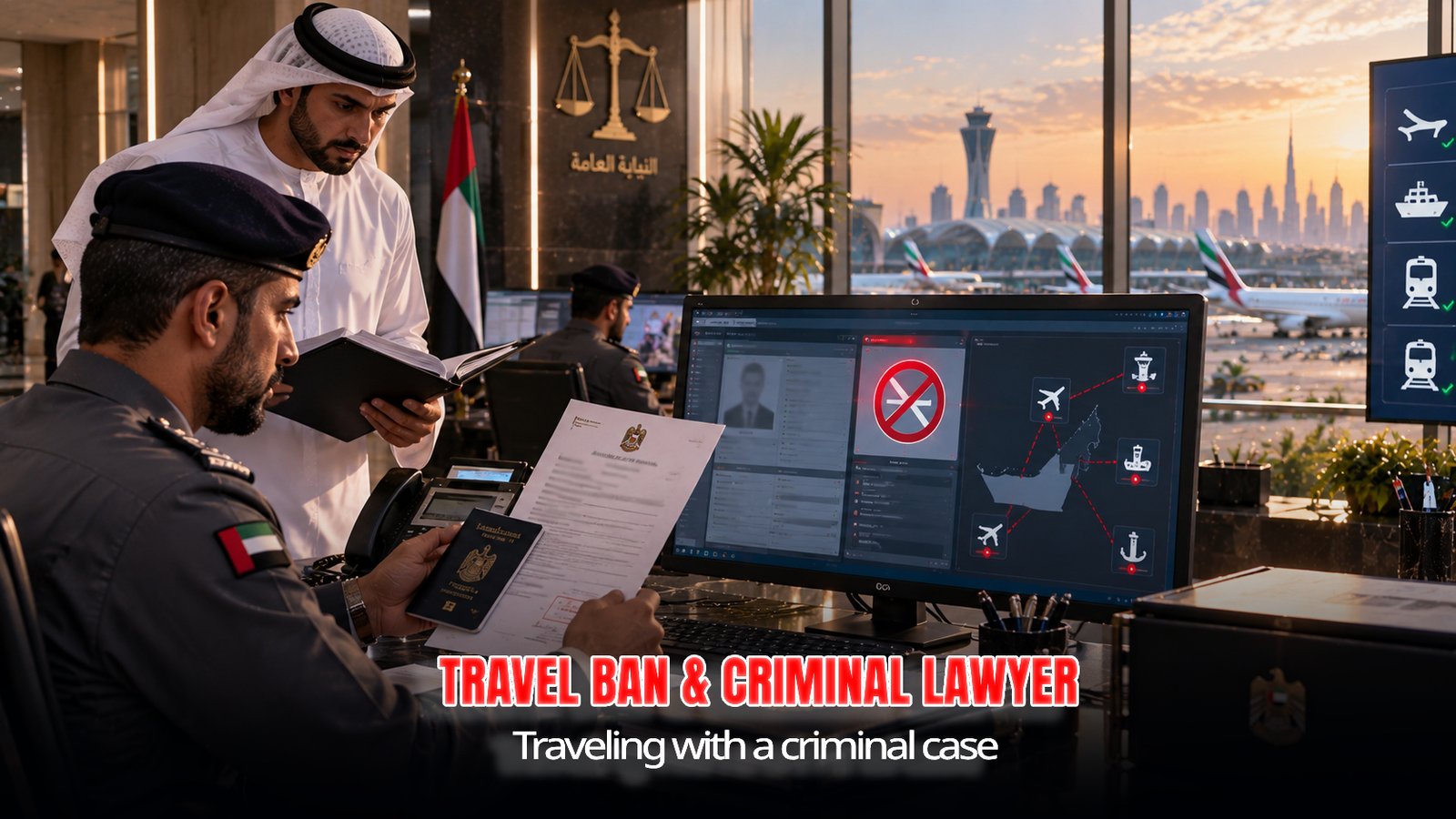
Having a criminal case in the UAE does not automatically mean that you are prohibited from leaving the country. However, travel may become impossible once a competent authority issues a travel ban, or where other restrictions apply to your case.
The key issue is not simply whether you have a criminal case. The important questions are: What stage has the case reached? Has a travel ban been issued against you? Which authority issued it? And is the ban still active?
Under UAE criminal procedure rules, the Public Prosecution may issue a travel ban against an accused person depending on the circumstances of the case. The law also regulates release on bail or personal guarantee, including situations where release is accompanied by a travel ban.
This makes it important to verify your legal position before booking a flight or going to the airport.
In this article, we explain whether you can travel with a criminal case in the UAE, when a criminal travel ban may be issued, the difference between a police complaint, a criminal case, a circular, and an arrest order, how to check whether you have a travel ban, how to request its lifting or seek permission to travel, and what may happen if you leave the UAE while criminal proceedings are ongoing.

Does Having a Criminal Case Automatically Prevent Me From Travelling?
No.
The existence of a police complaint or criminal case does not, by itself, automatically mean that a person is banned from travelling.
Article 99 of Federal Decree-Law No. 38 of 2022 on Criminal Procedure gives the Public Prosecution the authority to issue an order preventing an accused person from travelling in accordance with the circumstances of the case. The law also provides for the circulation of the travel-ban order at all entry and exit points.
Accordingly, a travel ban generally requires an actual legal decision or measure. Simply having a case number or police complaint does not, by itself, establish that you are prohibited from leaving the country.
This means that one person may have a criminal case without a registered travel ban, while another person involved in a different case may be subject to restrictions preventing departure.
What Determines Whether I Can Travel?
The following factors may need to be reviewed:
- The current stage of the case.
- The nature of the allegation.
- Any decision issued by the Public Prosecution or the court.
- The conditions of release.
- Whether a travel-ban order exists.
- Whether an arrest or bring-up order has been issued.
- Any other measures connected with the case.
- Whether there is a separate civil claim or enforcement matter.
Therefore, simply having your name connected to a criminal case is not enough to determine whether you can travel.
When Can a Travel Ban Be Issued in a Criminal Case?
One of the key provisions is Article 99 of the UAE Criminal Procedure Law.
Under this provision, the Public Prosecution may, depending on the circumstances of the case, issue orders relating to the accused, including a summons, arrest, or travel ban. A travel-ban order must contain the required details relating to the accused and the allegation, and the order is circulated to the relevant points of departure from the UAE.
This means that a travel ban may arise at an early stage of the case, including during the investigation before the matter reaches the court.
Does Every Criminal Case Result in a Travel Ban?
No.
There is no general rule that every criminal complaint or criminal case automatically results in a travel ban.
The competent authority considers the circumstances of the matter and the procedural requirements of the case, including the need to secure the accused person’s attendance.
Can the Public Prosecution Ban Me From Travelling?
Yes.
During the investigation stage, the Public Prosecution may issue a travel-ban order under Article 99 where the legal conditions and circumstances justify such a measure. Once issued, the order may be circulated at the country’s points of departure.
This is why it is important to distinguish between a simple police complaint and a criminal investigation being handled by the Public Prosecution.
A matter may initially be recorded as a police complaint and later be referred to the Public Prosecution if a formal criminal investigation is required.
Does a Police Complaint Prevent Me From Travelling?
Not merely because the complaint has been registered.
A police complaint does not automatically equal a travel ban.
However, this does not mean that a person should ignore the complaint and travel without checking the status of the matter. The case may progress to the Public Prosecution, where a travel ban or another measure relating to attendance or arrest may be issued depending on the circumstances.
If you know that a criminal complaint has been filed against you and you are planning to travel, you should determine whether the matter remains at the police stage or has already reached the Public Prosecution, and whether any restriction has been issued against you.
What Happens When a Criminal Case Is Referred to the Public Prosecution?
Once the matter reaches the Public Prosecution, the criminal investigation stage begins and the prosecution determines the appropriate measures under the law.
One of the important issues at this stage is whether the accused will be released.
Article 108 deals with temporary release, while Article 109 regulates release against a personal guarantee or bail and allows release to be accompanied by a travel ban, depending on the circumstances.
This is particularly important because some people assume:
Release = permission to travel.
That is not necessarily correct.
An accused person may be released from detention while remaining subject to a travel ban as a condition of release.
Can I Travel If I Have Been Released on Bail?
Not necessarily.
Article 109 allows release against a personal guarantee or bail and may provide for release with a travel ban. Bail is intended, among other things, to secure the accused person’s attendance and compliance with legal obligations.
Therefore, you should review the actual release decision and determine precisely what conditions have been imposed on you instead of assuming that release removes all restrictions.
If a travel ban remains active, attempting to leave the UAE without addressing the ban may result in you being stopped at the airport or another exit point.
Does Having My Passport With Me Mean That There Is No Travel Ban?
Not necessarily.
A travel ban and passport retention are not always the same legal measure.
A travel ban is an order preventing a person from leaving the UAE and may be circulated to the country’s points of departure.
A passport, on the other hand, may be held under a separate procedure connected with the criminal case, bail arrangements, or judicial custody.
Therefore, having your passport with you does not necessarily mean that no travel ban exists. Likewise, not having your passport does not, by itself, explain your full legal position.
The important issue is to identify the decisions recorded in the case and the restrictions actually imposed on you.
What Happens After the Criminal Case Is Referred to Court?
Once the criminal case reaches the court, matters relating to release, detention, and certain procedural measures may fall within the jurisdiction of the court hearing the case.
Article 113 of the UAE Criminal Procedure Law provides that the court to which the accused has been referred has jurisdiction to consider applications concerning release or detention and related decisions in accordance with the applicable legal provisions.
Accordingly, the authority dealing with your request may depend on the stage reached by the criminal proceedings.
Can I Travel Before the First Court Hearing?
It may be possible if there is no travel ban or other restriction preventing departure.
However, you should not rely simply on the fact that you have not received a notice informing you of a travel ban.
If the case has already been referred to court, you should know:
- The case number.
- The competent court.
- The date of the hearing.
- Your release status.
- Any attendance requirements.
- Whether a circular or travel-ban order exists.
Checking these matters before booking your trip is safer than discovering a problem at the airport.
Can I Travel If the Criminal Case Is a Misdemeanour?
The existence of a misdemeanour does not automatically mean that travel is prohibited.
There is no general rule that every misdemeanour automatically results in a travel ban. The actual decision and restrictions recorded in the case must be examined.
Therefore, it is not enough to say:
“It is only a misdemeanour, so I can travel.”
Likewise, it is not accurate to assume:
“It is a felony, so travelling is automatically impossible.”
The practical issue is whether a valid legal restriction preventing departure has been issued in the case.
Can I Travel If I Am Facing a Felony Charge?
This requires a more detailed review.
The seriousness of the allegation may affect the measures taken by the authorities, but there is no basis for treating every felony case as an automatic travel ban.
You need to determine whether the Public Prosecution or the court has issued a specific restriction preventing departure and whether there are conditions relating to release, attendance, or other procedural obligations.
How Can I Check Whether I Have a Travel Ban in the UAE?
Official verification is the most important step before travelling.
The UAE Government’s official portal advises travellers to check whether there is a travel ban or legal claim that could prevent them from leaving the country. It also refers to the available Dubai Police enquiry services and case-related enquiries through the Public Prosecution.
In Dubai, Dubai Police provides services for checking circulars and travel bans, subject to the scope of the service and the type of case.
The available enquiry procedures may differ depending on the emirate, the type of case, and the authority that issued the restriction.
The Main Ways to Check
You may start by checking the relevant services of:
Dubai Police, where the matter falls within its available enquiry services, or the Public Prosecution and competent judicial authority, depending on the stage of the case.
A lawyer can also review the case and determine the applicable decision and competent authority. This can be particularly important in criminal cases rather than simple financial disputes.
Can There Be a Circular Against Me Without Me Knowing?
Yes.
A restriction or procedural order may be recorded in the relevant systems without the individual knowing the full details until they make an official enquiry or attempt to complete a government procedure.
Therefore, relying on the assumption:
“No one contacted me, so I cannot have a travel ban”
is not a reliable way to determine your legal status.
Official verification is strongly recommended before travelling, especially if you know that a police complaint, investigation, or criminal case exists.
What Is the Difference Between a Criminal Case, a Circular, a Travel Ban and an Arrest Order?
This distinction is extremely important.
Criminal Case
A criminal case refers to the criminal proceedings arising from an allegation that a person committed an offence.
Travel Ban
A travel ban is a legal decision preventing a person from leaving the UAE in accordance with the applicable law and the authority’s jurisdiction.
Circular
A circular is an administrative or procedural measure through which information or an order issued by the competent authority is circulated through the relevant systems, points of departure, or authorities.
Arrest or Bring-Up Order
An arrest or bring-up order is intended to secure the person’s appearance before the competent authority in accordance with the law.
Several of these measures may exist in the same case, but they are not the same thing.
Can a Criminal Travel Ban Be Lifted in the UAE?
A request to lift or modify a travel ban may be possible depending on the authority that issued the ban, the stage of the case, and the legal basis for the restriction.
One of the most important issues is identifying the correct authority.
The request should not simply be submitted to any government entity.
If the case is still under investigation, the jurisdiction of the Public Prosecution should be considered. If the case has already been referred to court, the application may need to be submitted to the competent judicial authority depending on the procedural stage.
In Dubai, the official Dubai Courts service portal lists procedures including Grievance Against Travel Ban and Request for Travel Ban Lifting, in addition to services relating to criminal cases, release applications, and certain requests concerning departure from the UAE.
How Can I Request a Travel Ban Lift or Permission to Travel?
The first step is to identify:
Why was the travel ban issued, and which authority issued it?
After that, the appropriate application can be considered, such as a request to lift the ban or an application to obtain permission to travel under the procedures available for the case.
Depending on the circumstances, supporting documents may include:
- Medical reports.
- Documents relating to necessary treatment.
- Evidence of a death or exceptional family circumstances.
- Documented professional obligations.
- Travel and return information.
- Other documents supporting the reason for travel.
There is no guarantee that a request will be approved simply because supporting documents are submitted. The decision depends on the circumstances of the case and the competent authority.
Can I Request Temporary Travel Instead of Lifting the Travel Ban Permanently?
In some situations, the objective may not be to terminate the travel ban permanently but to obtain permission allowing the person to leave the UAE for a specific period or specific purpose, subject to the procedure accepted by the competent authority.
This is different from a permanent request to lift the travel ban.
For this reason, it is important to determine exactly what you need:
Do you want the travel ban to be lifted completely, or do you need permission to leave the UAE temporarily and return later?
Does a Travel Ban Automatically End When a Police Complaint Is Closed?
If the legal reason for the restriction has ended, the lifting of the travel ban may become possible.
However, you should not assume that a change in the status of the criminal case means that every restriction has already been removed from every relevant system.
It is therefore important to confirm that the travel ban or circular has actually been cancelled or removed through the competent authority.
This is particularly important when you have an upcoming flight.
What If the Court Acquits Me?
An acquittal changes the legal position of the criminal case.
However, before travelling, you should still confirm the status of any travel ban, circular, or other restriction connected with the case.
A court judgment and the administrative or electronic implementation of that judgment are not necessarily the same procedural step.
For this reason, it is advisable to verify that the related restrictions have actually been closed or removed before travelling.
What If the Court Imposes Only a Fine?
A fine does not automatically mean that every person is subject to a travel ban.
The issue depends on the judgment, enforcement procedures, and any accompanying orders.
Where separate civil or enforcement-related amounts exist, an independent travel ban may arise under civil enforcement rules.
It is therefore important not to confuse a criminal travel ban with a civil enforcement travel ban.
Can I Have a Civil Travel Ban While Also Facing a Criminal Case?
Yes.
Separate legal grounds may result in more than one type of restriction.
Federal Decree-Law No. 42 of 2022 on Civil Procedure regulates travel bans against debtors under Article 324 and establishes conditions relating to the debt and the risk of flight. The law also provides for the circulation of the travel-ban order at the relevant exit points.
Accordingly, a person may have:
A criminal case + a separate civil travel ban related to a debt or enforcement matter.
This is why it is important to determine the source and legal basis of the travel ban, rather than simply saying, “I have a travel ban.”
Can a Returned or Bounced Cheque Prevent Me From Travelling?
It is more accurate under the current legal framework not to assume that every returned cheque automatically results in a criminal travel ban.
The current rules governing cheques differ from the older approach that treated insufficient funds as automatically creating criminal liability in every situation.
However, a cheque may still have civil or enforcement consequences, and a civil travel ban may arise where the applicable legal conditions are satisfied.
The nature of the specific procedure therefore needs to be identified rather than assuming:
“Bounced cheque = criminal travel ban.”
What Happens If I Travel While a Criminal Case Is Pending?
The consequences depend on whether you travel while:
- A travel ban is already active.
- You are subject to release conditions.
- You have an obligation to appear before the competent authority.
- There are other orders connected with the case.
Where a travel ban exists, an attempt to leave the UAE may result in you being stopped at the point of departure because the ban has been circulated through the relevant systems.
Article 99 specifically provides for circulation of the travel-ban order at the country’s points of departure.
Even where no travel ban exists, this does not mean that ignoring investigation appointments, court hearings, or other legal obligations is safe. Additional procedural measures may arise depending on the nature and stage of the case.
Does Leaving the UAE Make the Criminal Case Go Away?
No.
Leaving the UAE does not automatically terminate or cancel a criminal case.
A person who is required to appear before the competent authority does not cease to be subject to the proceedings simply because they are outside the UAE.
The case may continue in accordance with the applicable procedural rules, and additional judicial or procedural measures may be taken where the accused fails to comply with attendance obligations or where other legal grounds arise.
Leaving the country is therefore not a legal method of closing a criminal case.

What Happens If I Leave the UAE Without Resolving a Travel Ban?
If a travel ban is already active, you may be stopped at the point of departure.
Failure to comply with release conditions or attendance requirements may also have additional procedural consequences. Depending on the circumstances, a new arrest or bring-up order may be issued where the legal conditions are satisfied.
The criminal procedure framework allows the competent authorities to take further measures where circumstances change, evidence becomes stronger, or the accused fails to comply with the required obligations.
Is It Risky to Travel Before a Travel Ban Is Issued?
It is not accurate to say that a person automatically commits an offence merely by leaving the UAE before a travel ban is issued.
A travel ban requires a legal decision.
However, travelling while a criminal case remains pending without knowing the actual status of the file can create practical and procedural risks, particularly if a restriction is issued while you are outside the UAE or if you fail to comply with attendance requirements.
Therefore, where you know that a criminal case is pending, it is important to verify the status of the case and any decisions issued before leaving the country.
Do Procedures Differ Between Dubai, Abu Dhabi and the Other Emirates?
The federal criminal procedure framework applies across the UAE within its scope, but the competent Public Prosecution or judicial authority may differ depending on the emirate and jurisdiction.
The available electronic services, enquiry procedures, and methods for submitting applications may also differ from one emirate to another.
In Dubai, Dubai Courts provides services relating to criminal cases, grievances, travel-ban lifting, and certain requests concerning departure and release.
For this reason, it is important to identify the emirate in which the criminal case was registered before submitting an application.
Do I Need a Criminal Lawyer If I Want to Travel While Facing a Criminal Case?
Not every person with a criminal case necessarily needs a lawyer simply because they want to travel.
However, legal review can be particularly useful when it is unclear:
- Whether a travel ban has been issued.
- Which authority issued it.
- Whether the case is with the police, Public Prosecution, or court.
- Whether there are release conditions.
- Whether there is an upcoming hearing.
- Whether an arrest or bring-up order exists.
- Whether there is a separate civil travel ban.
- Which procedure should be used to request permission to travel or lift the ban.
The main issue is not simply booking a ticket. The important step is knowing your actual legal status before booking the trip.
What Documents Does a Lawyer Need to Review My Travel Status?
The following documents can usually help in assessing the case:
- The case or complaint number.
- A copy of the Emirates ID, if available.
- A copy of the passport.
- Any release decision.
- A travel-ban decision, if available.
- Court hearing dates.
- Notices or summonses.
- Documents explaining the reason for travel.
- Any correspondence from the Public Prosecution or court.
The more complete the information available, the easier it is to identify the appropriate legal procedure.
Can a Travel Ban Be Lifted Electronically?
This depends on the emirate, type of travel ban, and authority that issued it.
In Dubai, the official Dubai Courts service portal provides procedures relating to travel-ban lifting and grievances against travel bans among its available judicial services.
For criminal matters, it is first necessary to determine whether the ban arose during the investigation stage or after the matter reached court, because the competent authority may differ depending on the procedural stage.
What Is the Difference Between a Criminal Travel Ban and a Travel Ban for Debt?
This is a very important distinction.
Criminal Travel Ban
A criminal travel ban is connected with criminal proceedings, including investigation or trial, and is governed by the applicable criminal procedure rules, including Article 99 of the Criminal Procedure Law.
Civil Travel Ban
A civil travel ban is generally connected with the protection or enforcement of a financial claim and is regulated by the Civil Procedure Law, including Article 324, which deals with travel bans against debtors.
Therefore, a person may have:
No criminal case but still have a civil travel ban.
Or:
A criminal case together with a separate civil travel ban.
Can I Travel If No Travel Ban Appears in the Official Enquiry?
If no travel ban appears in the appropriate official enquiry, that is not legally the same as saying that you have no criminal case.
A person may have a criminal case without a travel ban, while still being subject to other requirements such as attending a hearing or complying with an investigation.
The two questions should therefore be kept separate:
Do I have a criminal case?
and
Do I have a travel ban or another restriction preventing me from leaving the UAE?
What Should I Do Before Travelling While Facing a Criminal Case?
1. Find Out What Stage the Case Has Reached
Is it with the police, the Public Prosecution, or the court?
2. Check Whether a Travel Ban Exists
Do not rely on assumptions or on the fact that you previously travelled without any problem. The UAE Government recommends checking for travel bans or legal claims before travelling.
3. Review Your Release Conditions
If you were released on bail or personal guarantee, determine whether a travel ban or another restriction forms part of the conditions.
4. Check Your Attendance Dates
This is particularly important where there is an upcoming hearing or summons.
5. Identify the Authority That Issued the Restriction
This helps ensure that any request is submitted to the appropriate authority.
6. Do Not Travel Based on an Assumption
Having your passport with you or having travelled previously without difficulty does not mean that no new restriction has been issued.
Quick Guide: Can I Travel With a Criminal Case?
| Situation | Does It Automatically Mean There Is a Travel Ban? |
|---|---|
| A police complaint only | No |
| A case with the Public Prosecution | Not automatically, but the prosecution may issue a travel ban |
| Release of the accused | Does not necessarily mean permission to travel |
| Release with a travel ban | Departure is not allowed until the restriction is addressed |
| Case before the court | The case status and release conditions must be reviewed |
| Case ended with an acquittal | Any related restrictions should still be checked |
| Separate civil debt or enforcement matter | A separate civil travel ban may exist |
| No travel ban shown in an official enquiry | This does not necessarily mean there is no criminal case |
Does a Criminal Travel Ban Last Forever?
There is no general rule that a criminal travel ban lasts forever.
A travel ban is connected to a legal basis and procedural stage, and its status may change as the case develops or as new decisions are issued.
However, you should not assume that the ban disappears automatically simply because time has passed or the status of the case has changed.
Official verification remains the safest way to determine whether the restriction is still active.
What Should an Accused Person Do If There Is an Urgent Need to Travel?
Where there is a genuine and urgent reason to travel, such as necessary medical treatment, exceptional family circumstances, or an unavoidable professional obligation, the issue should be presented to the competent authority through the appropriate legal procedure, together with documents supporting the reason for travel.
Dubai Courts provides procedures relating to departure, grievances, and travel-ban lifting depending on the nature of the case.
However, submitting an application does not guarantee approval. The decision depends on the facts of the case, the supporting evidence, and the competent authority.
Legal Consultant Mohamed Jasem – Criminal Cases, Travel Bans and Permission to Travel in the UAE
Cases involving travelling while facing a criminal case require a clear understanding of the procedural stage and the measures recorded against the accused.
The existence of a criminal case does not automatically mean that travel is prohibited, just as the existence of a travel ban does not mean that the same solution applies to every case.
Legal Consultant Mohamed Jasem handles matters relating to travel bans connected with criminal cases, including reviewing the status of the case, identifying the competent authority, following up on applications to lift travel bans or obtain permission to travel, and handling release and bail procedures in criminal matters before the relevant authorities.
Depending on the circumstances, legal review may cover:
- Criminal travel-ban cases.
- Bail and release applications.
- Travel-ban lifting applications.
- Requests for permission to travel.
- Police complaints and criminal investigations.
- Criminal cases before the courts.
- Arrest and bring-up orders.
- Cases involving both criminal and civil liability.
- Verification of circulars and travel restrictions.
Conclusion
Having a criminal case in the UAE does not automatically prevent you from travelling.
However, travelling may become impossible where a travel-ban order or another legal restriction preventing departure has been issued.
Article 99 of the UAE Criminal Procedure Law gives the Public Prosecution the authority to issue a travel-ban order depending on the circumstances of the case and provides for circulation of the order at the country’s points of departure.
Article 109 regulates release against a personal guarantee or bail, including circumstances in which release may be accompanied by a travel ban. Once the accused has been referred to court, Article 113 addresses the court’s jurisdiction over matters relating to release and detention.
Therefore, do not rely only on the question:
“Do I have a criminal case?”
Instead, verify:
Case stage + competent authority + release conditions + actual travel ban or circular.
It is also important to distinguish between a criminal travel ban and a civil travel ban arising from a debt or enforcement procedure, because they have different legal foundations and procedures. Article 324 of the Civil Procedure Law regulates travel bans against debtors.
The UAE Government recommends checking for a travel ban or other legal claim that may prevent departure before travelling. Dubai Police and the relevant judicial authorities also provide channels for checking and dealing with certain restrictions.
If you have a criminal case and are planning to travel, do not leave the matter to assumption. Check the status of your case and any restrictions recorded against you before going to the airport.
Legal Disclaimer
This article is provided for general legal awareness and does not constitute legal advice for any specific case. The ability to travel, the existence of a travel ban, and the appropriate legal procedure depend on the stage of the case, the nature of the allegation, the decisions issued by the competent authorities, the applicable jurisdiction, and the legislation in force at the relevant time. It is recommended to obtain specialized legal advice before taking any action in relation to a criminal case or attempting to travel while criminal proceedings are ongoing.
Comments are closed