





A Child Visitation Case in the UAE is one of the important legal matters related to custody and divorce proceedings. It aims to regulate the relationship between a child and the non-custodial parent after the end of the marital relationship and ensure continued communication in a manner consistent with the child’s best interests.
Divorce may end the marital relationship, but it does not end a parent’s relationship with their children. Therefore, UAE law provides rules governing custody, visitation, and communication while placing significant importance on protecting the child and ensuring their best interests.
In this article, we explain the key issues relating to child visitation in the UAE, including who can request visitation, how to file a visitation case, the required documents, how the court determines visitation arrangements, and what happens if one parent refuses to comply with a visitation order.
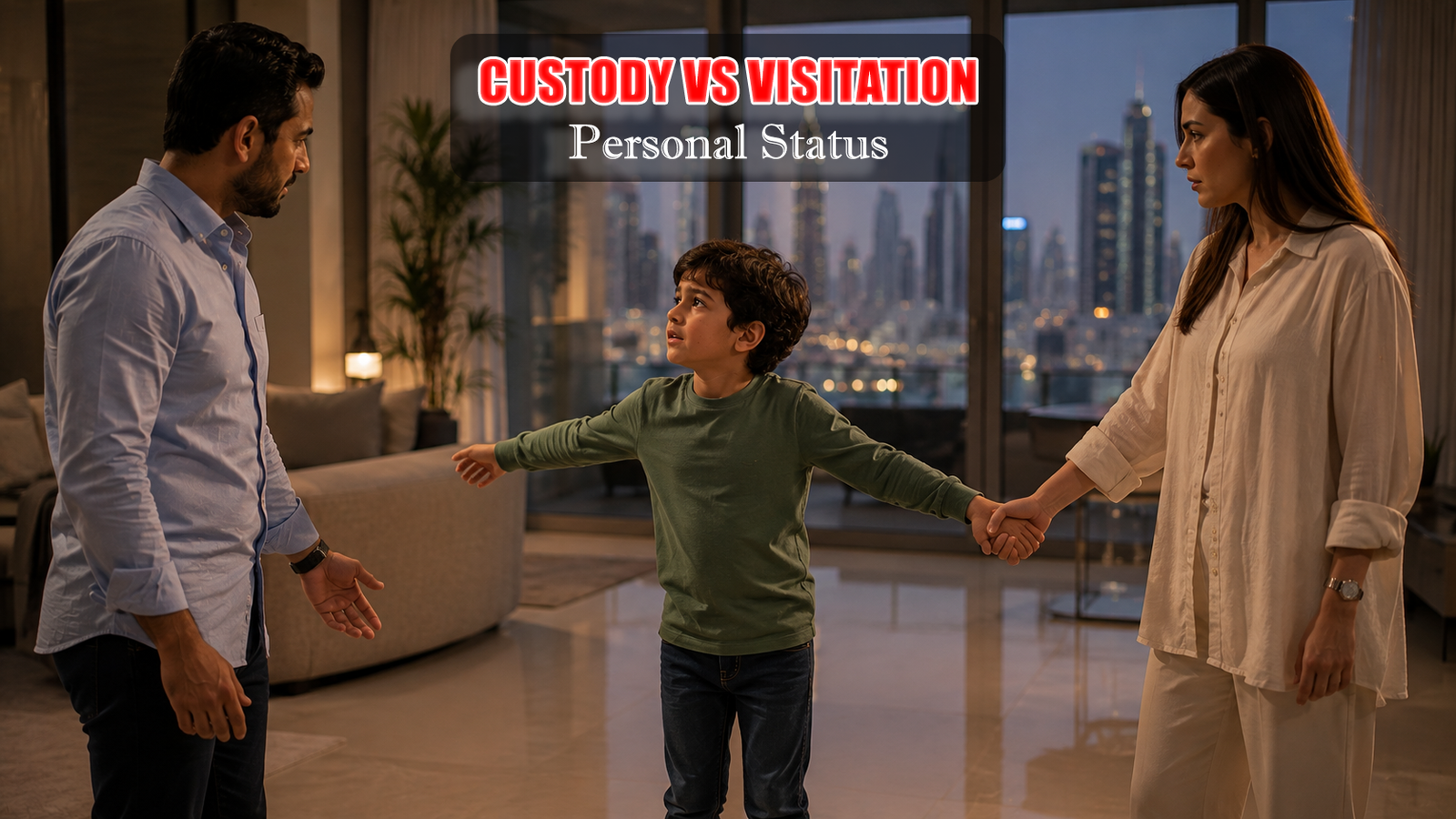
What Is a Child Visitation Case in the UAE?
A child visitation case is a legal procedure intended to regulate the right of a parent or another person with a legally recognized right to communicate with and visit a child when the parties cannot agree on how this right should be exercised.
Such cases commonly arise after divorce or separation, particularly when the child is in the custody of one parent while the other parent seeks to establish clear arrangements for visitation and communication.
The purpose of visitation is not to harm the custodial parent or reduce their rights. Instead, it is intended to preserve the family relationship and establish a balance between the rights of the parents and the best interests of the child.
Why Is Child Visitation Important After Divorce?
Divorce does not necessarily mean that all family relationships should end. Children generally benefit from maintaining a healthy relationship with both parents when such contact is safe and consistent with their interests.
Properly organized visitation can help:
- Preserve the child’s relationship with both parents.
- Reduce the psychological impact of divorce.
- Minimize repeated disputes between the parents.
- Establish clear visitation schedules.
- Prevent the child from being used as a means of pressure between the parents.
- Provide greater stability for the child.
Therefore, a Child Visitation Case in the UAE is not simply a legal procedure for arranging visits. It is a mechanism for organizing parental communication while protecting the child’s welfare.
What Law Governs Child Visitation in the UAE?
Custody and visitation matters falling within the scope of UAE personal status legislation are governed by Federal Decree-Law No. 41 of 2024 Concerning the Issuance of the Personal Status Law.
The law establishes rules relating to custody, the rights of the child, and the relationship between the child and their parents, while taking into consideration the child’s best interests and the circumstances of each case.
Accordingly, before initiating any visitation proceedings, it is important to determine the applicable law and the competent judicial authority.
Who Has the Right to File a Child Visitation Case?
Generally, the non-custodial parent has the primary interest in requesting the organization of child visitation when an agreement with the custodial parent cannot be reached.
For example, if the mother has custody of the child and the father cannot reach an agreement with her regarding visitation arrangements, he may seek legal intervention to establish a visitation schedule.
The same principle may apply where the father has custody and the mother is the non-custodial parent.
In certain circumstances, relatives may also have an interest in maintaining contact with the child. Such cases must be assessed according to the applicable legal provisions and the child’s best interests.
Does the Father Have the Right to See His Children After Divorce?
Yes. The fact that the mother has custody does not automatically mean that the father loses his right to maintain contact with his children.
However, the father’s exercise of this right must be consistent with the child’s best interests and should not negatively affect the child’s stability.
Parents may agree on visitation arrangements voluntarily. If they cannot reach an agreement, the matter may be brought before the competent court.
Does the Mother Have the Right to See the Child if the Father Has Custody?
Yes. If the father has custody of the child, the mother does not necessarily lose her right to maintain contact with her child.
Visitation arrangements should take into account the child’s age, education, daily routine, living arrangements, and overall welfare.
Custody and visitation are therefore two different legal matters. Granting custody to one parent does not automatically terminate the child’s relationship with the other parent.
What Are the Conditions for Filing a Child Visitation Case?
The procedural requirements may vary depending on the circumstances and the competent court. However, the applicant should have a clear legal basis for requesting visitation.
Important considerations may include:
- Evidence establishing the relationship between the applicant and the child.
- Evidence of divorce or separation where relevant.
- Clearly defined legal requests.
- Proposed visitation dates and arrangements.
- Supporting documents.
- Consideration of the child’s best interests.
- Evidence of attempts to reach an agreement where appropriate.
Simply stating that the other parent is preventing visitation may not always be sufficient. It can be useful to provide evidence showing attempts to reach an agreement or demonstrating an actual dispute concerning communication with the child.

What Are the Procedures for Filing a Child Visitation Case in the UAE?
The process generally begins by determining the competent judicial authority and the appropriate legal procedure.
The necessary documents and information should then be prepared.
Depending on the circumstances and applicable procedures, some family disputes may initially pass through family guidance or settlement procedures before being referred to the court.
If no agreement is reached, the case may be registered and the relevant requests and documents submitted. The court will then examine the circumstances and determine the arrangements it considers appropriate in light of the child’s best interests.
The request should be practical and specific, addressing questions such as:
- When will visitation take place?
- Where will the child be visited?
- How long will each visit last?
- Will visitation include weekends?
- Will it include public holidays and school vacations?
What Documents Are Required for a Child Visitation Case?
The required documents may vary depending on the court and the circumstances of the case.
However, documents that may be relevant include:
- Emirates ID.
- Passport, where required.
- Child’s birth certificate.
- Marriage certificate, where relevant.
- Divorce certificate or evidence of separation.
- Previous custody judgments.
- Previous visitation judgments.
- Evidence of attempts to reach an agreement.
- Correspondence or documents demonstrating a dispute concerning visitation.
Organizing the documents before filing can help present the facts clearly to the competent authority.
How Does the Court Determine the Child Visitation Schedule?
There is no single visitation schedule that applies to every family.
The court may consider factors such as:
- The child’s age.
- The child’s health.
- School schedule.
- Distance between the parents’ residences.
- The circumstances of both parents.
- The relationship between the parents.
- The child’s level of stability.
- The child’s best interests.
Visitation arrangements may include specific days during the week, weekends, school vacations, public holidays, and other special occasions, depending on the circumstances of the case.
Where Does Child Visitation Take Place?
The location of visitation may depend on the parents’ agreement, the court’s decision, and the circumstances of the child.
Visitation may take place at an agreed location or at a location determined by the competent authority.
In certain cases, a neutral location may be appropriate, particularly where there is significant conflict between the parents or circumstances requiring the visit to be organized in a way that reduces tension.
The primary objective is to provide a safe and suitable environment for the child.
Can Child Visitation Include Overnight Stays?
An overnight stay is different from a short visitation period and must be assessed according to the child’s age, circumstances, needs, and best interests.
Therefore, it cannot be assumed that every visitation order automatically includes overnight stays, nor that overnight visitation is prohibited in every case.
Any request for overnight visitation should be clearly presented and supported by reasons demonstrating that the proposed arrangement is appropriate for the child.
Can Child Visitation Arrangements Be Modified?
Yes. Visitation arrangements may need to be changed if the circumstances underlying the original arrangement change.
For example:
- The child may change schools.
- One parent may move to another location.
- The child’s needs may change.
- The parents’ working arrangements may change.
- The child may become older.
Any modification should continue to serve the child’s best interests rather than becoming a means of escalating conflict between the parents.
What Happens if the Custodial Parent Prevents Visitation?
If the custodial parent prevents the non-custodial parent from exercising visitation despite the existence of an enforceable agreement or court order, appropriate legal enforcement procedures may be available.
The affected parent should preserve evidence of the refusal, including relevant correspondence and documents, and approach the competent enforcement authority through the applicable legal procedures.
It is strongly advisable to avoid taking the child by force or engaging in direct confrontation with the custodial parent, as such actions may escalate the dispute and potentially harm the child.
What Happens if the Father Refuses to Return the Child on Time?
Just as the custodial parent must facilitate visitation according to the applicable arrangements, the parent exercising visitation must comply with the specified time, location, and conditions.
Visitation should not be used as a means of changing custody or keeping the child beyond the authorized period.
If a dispute arises concerning the return of the child, the matter should be addressed through the competent legal procedures, with the child’s safety and best interests remaining the priority.
Can the Father Be Prevented from Seeing His Children?
The right to communicate with a child is not necessarily absolute regardless of the child’s welfare.
If genuine circumstances indicate that visitation may pose a risk to the child, the court may examine the circumstances and determine the appropriate arrangement.
In some cases, rather than completely preventing communication, the court may impose specific conditions, such as:
- Visitation at a designated location.
- Supervised visitation.
- Specific visitation arrangements.
The appropriate arrangement depends on the facts of each case.
Can Children Be Visited Through Electronic Communication?
Modern communication technologies can help maintain the relationship between children and non-custodial parents, particularly when there is a significant geographical distance between them.
Video calls and telephone communication may be appropriate in certain circumstances, especially when direct visitation is temporarily difficult.
However, electronic communication does not necessarily replace direct visitation in every case. Its suitability depends on the circumstances of the child and any agreement or court order.
Does Child Visitation Differ When One Parent Lives Outside the UAE?
Yes. When one parent resides outside the UAE, the matter may become more complicated.
Issues may arise concerning:
- International travel.
- The child’s place of residence.
- Enforcement of judgments.
- Communication arrangements.
- Travel during school vacations.
- Requests to move the child outside the UAE.
Therefore, international visitation arrangements should be carefully assessed, particularly where there is a dispute concerning the child’s travel or relocation.

Can a Child’s Travel Be Prevented Because of a Visitation Dispute?
Travel, custody, and visitation are related but legally distinct issues.
The existence of a visitation case does not automatically mean that the child cannot travel.
If there are genuine concerns that taking the child outside the UAE could affect the other parent’s rights or place the child’s interests at risk, the matter should be presented to the competent judicial authority so that the appropriate legal decision can be made.
What Is the Difference Between Custody and Visitation?
One of the most common misunderstandings in family disputes is confusing custody with visitation.
Custody generally relates to the day-to-day care and welfare of the child.
Visitation relates to organizing communication and contact between the child and the non-custodial parent.
Therefore, granting custody to one parent does not mean that the child’s relationship with the other parent should automatically end.
The legal framework seeks to balance custody arrangements with the child’s right to maintain appropriate relationships with both parents.
Can Parents Agree on Visitation Without Filing a Case?
Yes. A voluntary agreement between the parents may be preferable to litigation when it is possible and protects the child’s interests.
Parents may agree on:
- Visitation days.
- Times for collecting and returning the child.
- Visitation location.
- School vacations.
- Public holidays.
- Special occasions.
- Telephone and video communication.
- Travel arrangements where legally permissible.
The agreement should be clear, practical, and capable of being implemented without conflicting with the child’s best interests.
What If One Parent Does Not Comply With a Visitation Agreement?
If the agreement is informal or does not have enforceable legal status, enforcing it may be more difficult than enforcing a court order.
If the dispute continues, it may therefore become necessary to take the appropriate legal action to formally regulate visitation.
The nature of the agreement and the available documents should be reviewed before determining the appropriate legal step.
What Are the Consequences of Failing to Comply With a Visitation Judgment?
Failure to comply with a judicial order may lead to enforcement measures and legal consequences depending on the nature of the violation, the wording of the judgment, and the circumstances of the case.
A visitation judgment should therefore not be treated as merely an optional arrangement.
At the same time, the non-custodial parent must also comply with the conditions and schedules established by the judgment.
Can a Visitation Judgment Be Modified?
Visitation arrangements may be reconsidered when circumstances change or new reasons arise that justify a different arrangement.
For example, the child may become older, change schools, or experience a change in living arrangements. One of the parents may also relocate or experience significant changes in employment.
In such circumstances, the previous judgment and the new circumstances should be reviewed to determine the appropriate legal procedure.
Why Is the Child’s Best Interest Important in Visitation Cases?
The child’s best interests should remain central to any custody or visitation dispute.
A visitation case should not become a tool for revenge or pressure between parents.
Likewise, children should not be used to communicate or escalate disputes between their parents.
A clear and cooperative arrangement between the parents can provide the child with greater stability and reduce the negative effects of family conflict.
Frequently Asked Questions
Does the father have the right to see his children after divorce?
Yes. The father, as the non-custodial parent, may have visitation and communication rights that can be organized through parental agreement or a judicial decision, subject to the child’s best interests.
Does the mother have the right to see her children if the father has custody?
Yes. The mother may have the right to maintain contact and visitation when the father has custody, subject to the applicable legal arrangements and the child’s best interests.
How often can a father see his child?
There is no single schedule applicable to every case. The frequency and timing of visitation may be established by agreement or determined by the competent authority according to the child’s circumstances.
Does visitation include overnight stays?
Not automatically. Overnight stays depend on the circumstances of the child, the child’s age and needs, and the arrangements approved by the competent authority.
What can I do if the mother prevents me from seeing my son?
If there is an enforceable court order or legally enforceable arrangement, the affected parent may pursue the appropriate legal enforcement procedures. Direct confrontation or taking the child by force should be avoided.
Can a father be prevented from seeing his child?
Restrictions may be imposed in exceptional circumstances where the child’s welfare requires them. The appropriate arrangement depends on the facts of the case.
Can a visitation order be modified?
Yes. A modification may be considered when circumstances change or new circumstances arise that justify changing the existing visitation arrangements.
Can a visitation case be filed without divorce?
The applicable procedure may differ depending on whether the marriage is still in place, whether the parties are separated, and whether there is an existing custody dispute. The family’s legal circumstances should therefore be assessed before selecting the appropriate procedure.
Does visitation law differ for residents and UAE citizens?
Nationality alone does not necessarily determine the applicable rights. The applicable law, jurisdiction, family relationship, and circumstances of the case must first be determined.
How Should You Prepare for a Child Visitation Case in the UAE?
Before filing a Child Visitation Case in the UAE, it is advisable to collect documents relating to the child, custody, divorce, previous judgments, and any existing agreements.
The requested visitation arrangements should also be clearly defined. Instead of simply stating, “I want to see my children,” it is better to identify:
- The proposed visitation days.
- The proposed times.
- The visitation location.
- School vacation arrangements.
- Public holidays.
- Special occasions.
- Communication arrangements.
- Any proposed overnight arrangements, where appropriate.
Where there is significant conflict between the parents, obtaining appropriate legal advice can help determine the best way to protect the parent’s communication rights while avoiding unnecessary harm to the child.

Conclusion
A Child Visitation Case in the UAE is not merely a procedure for obtaining a specific time to visit a child. It is a legal mechanism designed to regulate family relationships following divorce or separation while balancing parental rights with the child’s best interests.
The end of a marriage does not necessarily mean the end of a parent’s role in the child’s life. When parents cannot reach a voluntary agreement, the competent authorities can establish visitation arrangements that take into account the child’s age, education, health, living arrangements, and overall welfare.
When a dispute arises concerning visitation, it is important to review any existing custody or visitation judgments, preserve relevant evidence, identify the appropriate legal requests, and follow the applicable enforcement procedures.
Comments are closed