










Some people believe that writing and signing a private marriage agreement is sufficient to establish a legally recognised marriage in the United Arab Emirates. However, when a dispute arises, or one spouse seeks divorce, maintenance or other legal rights, they may discover that the position is more complicated than simply producing a document signed by both parties.
UAE law does not treat every form of undocumented marriage as the same legal situation. It is essential to distinguish between a marriage contract that fulfils the required legal elements and conditions but has not been officially registered, and a contract that is missing an essential element or condition of validity. Each situation may have different legal consequences.
This distinction becomes particularly important where children are involved, one spouse denies the marriage, one party dies before the marriage is documented, or a dispute arises over the dowry, maintenance, inheritance or proof of parentage.
In this article, Legal Consultant Mohammed Jasem explains the legal position of customary marriage in the UAE, whether courts recognise undocumented marriage contracts, the conditions a court examines, the evidence that may be used to establish a marriage, and the legal consequences under applicable UAE legislation.
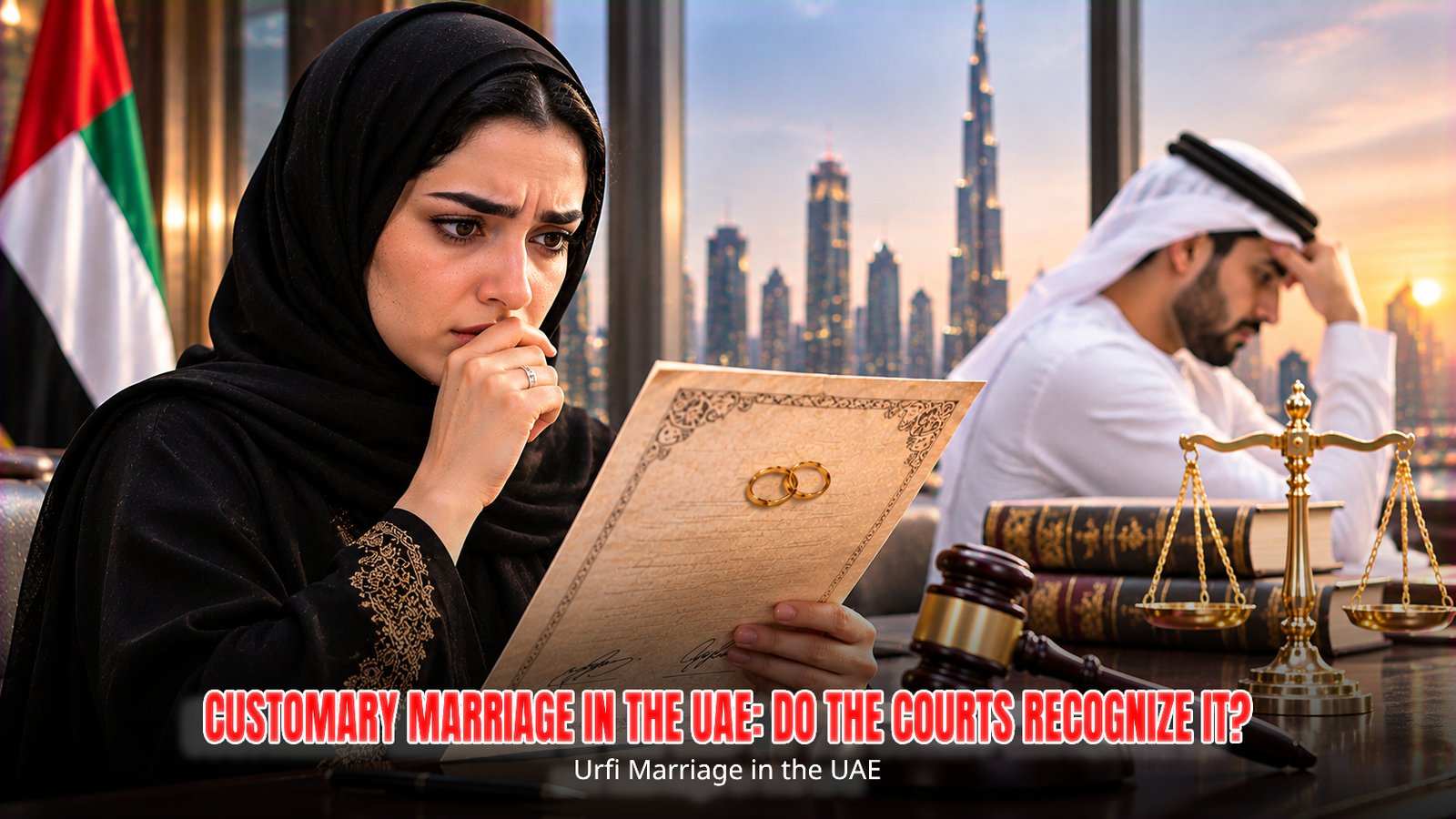
Is Customary Marriage Legal in the UAE?
This question cannot be answered with a simple yes or no without examining the nature of the marriage contract and the circumstances in which it was concluded.
Under Article 41 of Federal Decree-Law No. 41 of 2024 on the Issuance of the Personal Status Law, a marriage contract must be documented before the court in accordance with the applicable legislation. The same article allows any interested party to request judicial proof of an undocumented marriage contract.
This means that the absence of official registration does not automatically make every undocumented marriage void. A marriage contract may have fulfilled its legal elements and conditions even though the parties did not complete the official documentation process. In such circumstances, an interested party may apply to the competent court to establish the marriage.
However, this does not mean that every private document or verbal agreement between a man and a woman constitutes a valid marriage, or that a court will recognise it simply because it has been submitted as evidence. The court must examine the essential elements and conditions of the marriage, assess the available evidence and determine which law applies to the parties.
The central legal principle is that recognition of an undocumented marriage depends on proving that a valid marriage contract was concluded under the applicable law, not merely on describing the relationship as a customary marriage.
The Difference Between Customary Marriage, Undocumented Marriage and Official Marriage
The expression customary marriage is commonly used to describe different types of arrangements and contracts. From a legal perspective, however, it is important to distinguish between the following situations.
1. A Valid but Undocumented Marriage
This is a marriage contract in which all the legal elements and conditions required by the applicable law have been fulfilled, but the spouses have not registered it with the competent court.
Such a contract may be capable of being established through court proceedings under Article 41 of the UAE Personal Status Law, provided that the interested party submits sufficient evidence of its conclusion and validity.
2. A Void or Defective Marriage Contract
A marriage contract may be legally defective where an essential element or condition of validity is missing, depending on the legal classification determined by the court.
The existence of signatures, witnesses or a written document does not, by itself, establish that the contract is valid. The court must identify the nature of the defect and determine its legal consequences under the applicable legislation.
3. An Officially Registered Marriage
An official marriage is concluded in accordance with the approved legal procedures and registered with the competent court or authority, resulting in an official marriage certificate.
Official documentation remains the safest way to establish the marital relationship and present proof of it to government authorities and courts, without first having to initiate legal proceedings to establish the existence of the marriage.
Which Laws Govern Customary Marriage in the UAE?
Federal Decree-Law No. 41 of 2024 on the Issuance of the Personal Status Law is the principal legislative reference for marriage matters falling within its scope of application.
The law replaced the former Federal Law No. 28 of 2005 on Personal Status and entered into force on 15 April 2025.
Several provisions are particularly relevant to undocumented marriage contracts:
- Article 25: Regulates the offer and acceptance required for a marriage contract.
- Article 26: Sets out the conditions for a valid marriage contract.
- Article 27: Establishes the requirements applicable to marriage witnesses.
- Article 34: Addresses the conclusion of marriage through offer and acceptance.
- Article 35: Distinguishes between valid and invalid marriage contracts.
- Article 36: Provides that the effects of a valid marriage contract arise from the date it was concluded.
- Article 37: Addresses circumstances in which a marriage contract is invalid.
- Articles 38 and 39: Regulate certain consequences of void and defective marriage contracts.
- Article 41: Requires the documentation of marriage contracts and permits an interested party to seek proof of an undocumented marriage.
The applicable rules may differ according to the parties’ religion, nationality and the law they are legally entitled to invoke. It is therefore incorrect to apply the same marriage requirements to every case without first examining the scope of the relevant legislation.
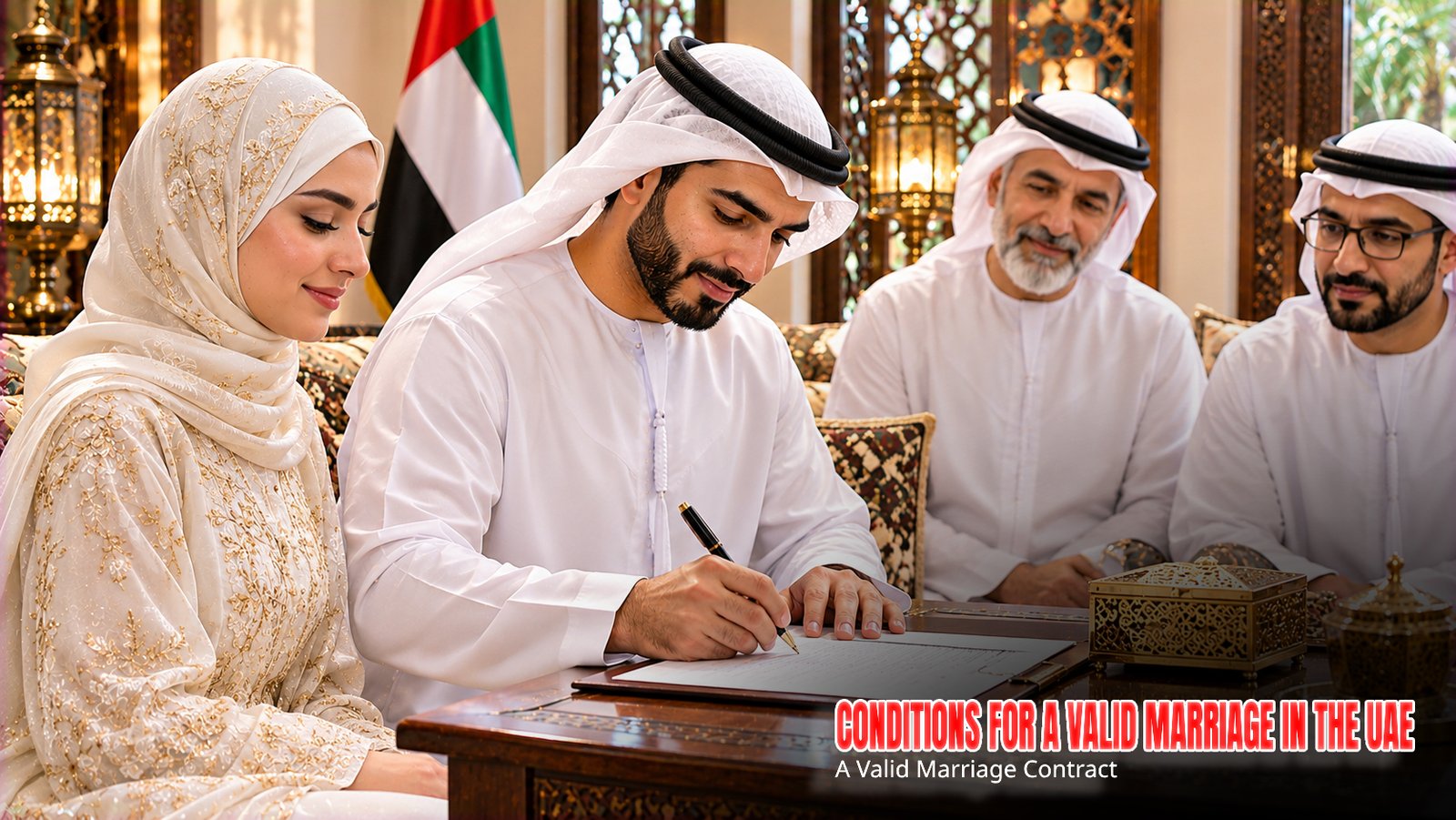
What Are the Legal Requirements for a Valid Marriage Under UAE Personal Status Law?
The existence of a written document is not sufficient to establish a valid marriage. The court must examine the legal elements and conditions prescribed by the applicable legislation.
For cases governed by Federal Decree-Law No. 41 of 2024, the principal requirements include the following.
1. Offer and Acceptance
The marriage must be concluded through a clear offer and acceptance expressing the intention to enter into marriage. The offer and acceptance must correspond and comply with the legal requirements.
Article 25 regulates the requirements for offer and acceptance, including clarity, consistency and their connection within the same contractual session in accordance with the law.
2. The Wife’s Consent
The law requires the wife’s consent. A marriage cannot validly be concluded without satisfying this requirement.
Article 26 expressly includes the wife’s consent among the conditions for a valid marriage contract.
3. The Guardian in the Marriage of a Muslim Woman
The law requires the offer to be made by the woman’s guardian where the prospective wife is Muslim, subject to the exception under Article 26 for a non-UAE national Muslim woman whose national law does not require a guardian for marriage.
The law also addresses circumstances in which the guardian cannot attend or refuses to arrange the marriage, allowing the court to intervene in accordance with the applicable legal conditions.
4. Witnesses to the Marriage Contract
Article 26 requires two witnesses, while Article 27 sets out the relevant qualifications.
These include being legally competent adults who hear the offer and acceptance and understand their meaning. A witness must also be Muslim where the husband is Muslim, in accordance with the statutory requirements.
5. Absence of Legal Impediments to Marriage
There must be no permanent or temporary legal or Sharia-based impediment preventing the marriage. Depending on the circumstances, this may include certain degrees of prohibited kinship, an existing marriage or a waiting period following a previous marriage.
Important legal note: Marriage requirements should not be reduced to the existence of a guardian and two witnesses alone. The court considers the complete set of legal elements, conditions and impediments and applies the law governing the particular relationship.
Does a Customary Marriage Give the Wife Legal Rights?
If the court establishes that the marriage contract is valid and fulfils the required legal elements and conditions, the absence of official documentation does not, in principle, eliminate its legal effects. This follows from Article 36 of the UAE Personal Status Law.
However, it is important to distinguish between having a legal right and being able to enforce that right in practice. A wife who does not possess an official marriage certificate may first need to establish the marriage before the court before pursuing claims based on the marital relationship.
Depending on the circumstances and applicable legal provisions, potential claims may include:
- Dowry (Mahr): Including any immediate or deferred dowry established by the contract and supporting evidence.
- Marital maintenance: Where the legal requirements for entitlement to maintenance are satisfied.
- Financial rights following divorce: Depending on the type of marital dissolution, the circumstances of the case and the applicable statutory provisions.
- Children’s rights: Including parentage, maintenance, custody and other matters determined by the court in accordance with the child’s best interests and applicable law.
If the contract is classified as void or defective, it should not be assumed that all the rights associated with a valid marriage will automatically apply. The law provides different rules and consequences for different types of invalid marriage contracts.
What Is the Penalty for Customary Marriage in the UAE?
A common misconception is that every customary marriage is automatically punishable by imprisonment or deportation simply because it has not been officially documented.
The more accurate legal approach is to distinguish between failure to document a marriage contract and conduct that may constitute a separate criminal offence under the UAE Crimes and Penalties Law.
Article 41 of the Personal Status Law allows an interested party to request proof of an undocumented marriage. This confirms that the absence of documentation may be addressed through personal status proceedings seeking to establish the marriage.
On the other hand, criminal issues may arise if no valid marriage is established or if the circumstances involve other conduct punishable under the law. This requires examining the facts, the available evidence and the specific criminal provision that may apply. It is not legally accurate to conclude that a criminal offence or penalty automatically arises merely because a relationship is described as a customary marriage.
Article 409 of the Crimes and Penalties Law addresses specific forms of consensual sexual conduct and provides particular rules and conditions relating to complaints and waiver. It should not be considered in isolation or treated as an automatic penalty applicable to every undocumented marriage.
Accordingly, the potential criminal risks must be assessed carefully, taking into account the validity of the contract, the status and ages of the parties, the circumstances of the case and the applicable law.
How Can Customary Marriage Be Proven Before a UAE Court?
Article 41 of Federal Decree-Law No. 41 of 2024 allows any interested party to request judicial proof of an undocumented marriage contract.
Depending on the circumstances, the appropriate legal route may involve filing an application or claim before the competent court, supported by evidence and documents demonstrating that the marriage took place and fulfilled the required conditions.
The following types of evidence may be relevant.
1. The Written Customary Marriage Contract
If the parties possess a document containing their names, the date of the marriage, its terms and their signatures, it may be submitted to the court for examination.
The court may assess its authenticity, evidential value and whether it supports the conclusion that a marriage contract was validly concluded.
However, the existence of the document alone does not resolve the dispute or replace the need to establish the legal elements and conditions of marriage.
2. Witness Testimony
Statements from individuals who attended the marriage or heard the offer and acceptance may be relevant, particularly where there is a dispute about the presence of the guardian, witnesses or the circumstances in which the marriage was concluded.
The court evaluates witness testimony in accordance with the applicable rules of evidence and the specific legal requirements governing marriage contracts.
3. Admission by the Other Party
If one of the parties admits that the marriage took place, that admission may have significant evidential value in the proceedings, subject to the applicable legal requirements governing its validity and effect.
4. Correspondence and Electronic Documents
Messages, electronic conversations and digital documents may help establish certain facts connected with the relationship or the marriage contract.
Their relevance depends on their content, how they were obtained and whether their authenticity and attribution to the relevant parties can be established.
However, electronic conversations should not automatically be treated as conclusive proof of a valid marriage. They must be assessed alongside the other evidence and the applicable legal requirements.
5. Documents Relating to Children or Shared Residence
Certain documents relating to children, shared accommodation or transactions in which one party acknowledged the relationship may be relevant to the evidential assessment.
Nevertheless, proving cohabitation or a shared residence does not automatically establish the existence of a valid marriage contract. Each fact has its own evidential significance, which the court evaluates in the context of the case.
What Is the Difference Between a Void and a Defective Marriage Contract Under UAE Law?
The UAE Personal Status Law distinguishes between a void marriage contract and a defective marriage contract. These terms should not be treated as interchangeable because they may produce different legal consequences.
Void Marriage Contract
Under Article 38, a void marriage contract produces no legal effect before consummation.
After consummation, however, certain consequences arise as prescribed by law, including the waiting period and establishment of parentage.
Defective Marriage Contract
Article 39 regulates the consequences of a defective marriage contract. The court shall revoke such a contract, and it generally produces no legal effect before consummation, subject to the statutory exception relating to divorce pronounced by the husband.
After consummation, the law recognises certain consequences, which may include:
- Entitlement to the specified dowry or the customary dowry where no amount was specified.
- Establishment of parentage.
- The obligation to observe the waiting period.
- The prohibition arising from affinity.
- The wife’s entitlement to maintenance, subject to the statutory conditions and the exception where she knew that the contract was defective.
Article 40 also allows the spouses to conclude a new marriage contract that fulfils the required elements and conditions without first obtaining a judicial ruling revoking the previous defective contract, provided that the applicable marriage documentation procedures are followed.
This distinction is particularly important because the legal classification of the contract helps determine the rights, obligations and consequences that may be claimed.
Can Children Born from a Customary Marriage Have Their Parentage Established?
Yes. Establishing the parentage of children may be considered by the court where an undocumented marriage is involved. However, the legal basis for establishing parentage must be identified according to the circumstances of the case.
If a valid marriage is established, parentage may be examined under the applicable legal provisions. The law also recognises certain consequences relating to parentage in specific cases involving void or defective marriage contracts after consummation.
Depending on the nature of the dispute and the available documents, it may be necessary to file a separate parentage claim or submit related applications as part of the proceedings concerning the marriage.
It is important not to confuse proof of marriage with proof of parentage. These are separate legal issues that may be connected within the same proceedings, but each has its own requirements, evidence and legal consequences.
The priority in such cases is to protect the child’s rights and complete the legal procedures necessary to establish parentage and obtain the relevant official documents.

What Happens If One Spouse Dies Before the Marriage Is Officially Documented?
An undocumented marriage may lead to a complicated legal dispute if one spouse dies, particularly where the heirs deny the existence of the marital relationship or refuse to recognise it.
In such circumstances, the interested party may need to establish the marriage before the court before seeking the legal consequences arising from it, including inheritance rights where the relevant legal requirements are satisfied.
Potential evidence may include:
- The written customary marriage contract.
- Testimony from witnesses.
- Previous admissions made by the deceased.
- Correspondence and documents supporting the circumstances of the marriage.
The existence of a relationship or shared residence does not automatically create an inheritance entitlement. The marital status must first be established in accordance with the applicable law, after which the relevant inheritance rules can be applied.
Are the Rules on Customary Marriage Different for Non-Muslims in the UAE?
Yes. This is an essential issue that must be examined before providing legal advice.
Federal Decree-Law No. 41 of 2022 on the Civil Personal Status regulates personal status matters for non-Muslims within its scope of application, subject to the applicable exceptions and legal choices available under the legislation.
The law provides for civil marriage and the procedures for concluding and documenting it before the competent authentication judge. As a general requirement under the federal civil personal status framework, both parties must have attained the age of 21 Gregorian years, in addition to satisfying the other conditions set out in the law and its Executive Regulation.
Accordingly, the guardian and witness requirements under the general Personal Status Law should not automatically be applied to civil marriages for non-Muslims in the same way. Equally, a private customary document should not be treated as a substitute for the legally prescribed civil marriage procedures.
The applicable procedures may vary according to the emirate and competent judicial authority. Specific arrangements for civil marriage services operate in places including Abu Dhabi and Dubai.
What Documents Should Be Kept in Cases Involving an Undocumented Marriage?
Where an undocumented marriage exists or a dispute may arise, it is important to preserve all documents and evidence that may help establish the relevant facts.
These may include:
- The original customary marriage contract and any copies.
- The guardian’s and witnesses’ details and contact information.
- Messages and conversations containing an admission of the marriage or details about how it was concluded.
- Documents relating to the dowry or financial agreements.
- Documents relating to children, if any.
- Official documents containing the parties’ details or referring to their relationship, where relevant.
- Any previous judgments or applications concerning the marriage, divorce or parentage.
Electronic evidence should be preserved in its original form as far as possible. It should not be altered or deleted, and the legal requirements governing its submission and use must be observed.
How Can a Legal Consultant Help With Customary Marriage Cases?
The appropriate legal response does not begin simply by filing a claim to establish a marriage. It begins with identifying the nature of the contract, determining which law governs the relationship and selecting the appropriate legal procedure based on the available evidence and the rights in dispute.
In cases involving customary or undocumented marriage, the legal assessment may include:
- Reviewing the marriage contract: Examining the written document or agreement and assessing whether it fulfils the required legal elements and conditions.
- Identifying the applicable law: Considering the parties’ religion, nationality and the legal rules governing their relationship.
- Assessing the evidence: Reviewing witness statements, correspondence, admissions and documents, and evaluating their ability to establish the relevant facts.
- Determining the appropriate court procedure: Considering whether to file a claim to establish the marriage, establish parentage or pursue related legal claims.
- Protecting legal rights: Assessing potential claims involving dowry, maintenance, children and inheritance in light of the facts and applicable legislation.
Legal Consultant Mohammed Jasem emphasises that undocumented marriage cases require careful legal assessment. Incorrectly classifying the contract or choosing an unsuitable legal procedure may affect the course of the proceedings and the rights that can be pursued.
Frequently Asked Questions About Customary Marriage in the UAE
Do UAE courts recognise customary marriage?
A UAE court may consider an application to establish an undocumented marriage under Article 41 of Federal Decree-Law No. 41 of 2024, provided that the interested party proves that a marriage contract was concluded and fulfilled the elements and conditions required by the applicable law.
Is customary marriage valid if both the husband and wife signed a document?
Not necessarily. The signatures of both parties on a private document are not, by themselves, sufficient to establish a valid marriage. The court must examine the offer and acceptance, consent, guardian and witnesses where applicable, and the absence of legal impediments, according to the law governing the case.
Can a wife file a claim to establish a marriage in the UAE?
Yes. An interested wife may request judicial proof of an undocumented marriage before the competent court and submit evidence demonstrating that the marriage was concluded and satisfied the applicable legal requirements.
Is a wife entitled to maintenance under a customary marriage?
If the marriage is established as valid and the legal conditions for maintenance are satisfied, a maintenance claim may be considered under the applicable law. Where the marriage has not been documented, it may first be necessary to establish the marital relationship before pursuing the claim.
Can children born from a customary marriage have their parentage established?
Parentage may be established in accordance with the applicable legal provisions, whether the claim is based on a valid marriage or one of the circumstances in which the law recognises consequences following consummation of a void or defective contract. The court determines the appropriate means of proof according to the circumstances of the dispute.
Can a person be imprisoned for customary marriage in the UAE?
It is not legally accurate to say that the mere failure to document a marriage contract automatically results in imprisonment. However, criminal liability may arise if the elements of a separate criminal offence are established under the Crimes and Penalties Law. Each case must be assessed individually.
Can a customary marriage be officially documented after it has taken place?
It may be possible to establish an undocumented marriage through the court or complete the appropriate legal procedures, depending on the nature of the contract and whether it fulfils the required conditions. This does not mean that every customary marriage contract can automatically be converted into a valid marriage.
Is a guardian required for customary marriage in the UAE?
For a Muslim woman, the law requires the offer to be made by her guardian, subject to the specific exception for a non-UAE national Muslim woman whose national law does not require a guardian. The law governing the particular case must be examined before reaching a conclusion.
Are the rules on customary marriage different for Muslims and non-Muslims?
Yes. The applicable rules depend on the parties’ religion and the law governing their relationship. Where its requirements are satisfied, civil marriage for non-Muslims is governed by Federal Decree-Law No. 41 of 2022 on the Civil Personal Status, subject to its scope and applicable exceptions.
Conclusion: Do Not Leave Your Legal Rights Unprotected Because of an Undocumented Marriage
Customary marriage in the UAE is not a legal classification that, by itself, determines whether a relationship is valid or invalid. The decisive factors are the actual nature of the contract, its legal elements and conditions, and the law applicable to the parties.
The law may allow an undocumented marriage to be established through court proceedings where the contract fulfils the required conditions. The legal consequences may be different where the contract is found to be void or defective.
Taking timely legal advice is particularly important where children are involved or disputes arise over maintenance, dowry, divorce or inheritance.
A careful review of the marriage contract and supporting evidence before taking legal action can help identify the appropriate legal route and protect the parties’ rights under UAE legislation.
Legal Assistance From Legal Consultant Mohammed Jasem
If you are involved in a dispute concerning a customary or undocumented marriage in the UAE, Legal Consultant Mohammed Jasem can assist with reviewing the available documents, assessing the applicable legal framework and identifying the appropriate steps to protect your rights.
The correct legal approach depends on the specific facts, the validity of the marriage contract and the legislation governing the parties.
Disclaimer: This article provides general legal information about customary and undocumented marriage in the UAE. It does not constitute legal advice for a particular case. The applicable law and legal outcome depend on the facts, the parties’ circumstances and the competent court’s assessment.
Comments are closed