










A commercial trade licence is one of the most important documents establishing a business’s legal status and the activities it is authorised to conduct in Dubai. Creating a counterfeit licence, altering its details or knowingly using a forged document to mislead another party may result in criminal liability, in addition to potential commercial and financial consequences for the individual, company or affected parties.
Understanding the penalty for forging a commercial licence in Dubai is particularly important as government authorities increasingly rely on digital systems to issue licences and verify company information. Forgery is no longer limited to altering paper documents, stamps or signatures. Depending on the circumstances, it may also involve manipulating electronic government documents or their digital information.
In this legal guide, Legal Consultant Mohammed Jasem explains the UAE legal framework governing commercial licence forgery, the potential penalties, the distinction between forgery and knowingly using a forged document, how to verify a trade licence and the key legal considerations when investigating or defending such cases.

1. Legal Classification of Commercial Licence Forgery in Dubai
The legal classification of commercial licence forgery depends on several factors, including:
- The nature of the document.
- The authority that issued it.
- The method used to alter or fabricate it.
- How the document was subsequently used.
- The available evidence concerning the accused person’s knowledge and intention.
A commercial trade licence may qualify as an official document if it meets the legal requirements for that classification. Special provisions concerning electronic government documents may also apply where the forgery involves a digital version of the licence or its electronic data.
Simply describing a document as a commercial licence does not determine the applicable criminal penalty. The relevant legal provision must be identified based on the precise conduct involved, such as creating an entirely counterfeit licence, altering its details, forging a copy or knowingly using a forged document.
It is also essential to distinguish forgery from an expired or unrenewed licence, or from conducting activities outside the scope of an existing licence. These situations may give rise to commercial or regulatory violations, but they do not automatically constitute criminal forgery.
2. Which UAE Laws Govern Commercial Licence Forgery?
Several UAE laws may be relevant when assessing a suspected commercial licence forgery case.
2.1 Federal Decree-Law No. 31 of 2021 on Crimes and Penalties
The UAE Crimes and Penalties Law establishes the general rules governing document forgery.
Relevant provisions include:
- Article 251: Defines document forgery and the methods through which the authenticity of a document may be altered.
- Article 252: Establishes the penalty for forging official and unofficial documents.
- Article 253: Addresses the forgery of copies of official documents and the knowing use of forged copies.
- Article 258: Addresses the knowing use of forged documents.
The applicable provision depends on the nature of the document and the specific conduct under investigation.
2.2 Federal Decree-Law No. 34 of 2021 on Countering Rumours and Cybercrimes
This legislation may apply where the alleged forgery concerns an electronic document belonging to a government authority or another entity covered by the relevant provisions.
Article 14 addresses the forgery of electronic documents and establishes specific penalties depending on the entity to which the document belongs.
2.3 Commercial Licensing and Regulatory Legislation
The laws and regulations governing commercial licensing must also be considered to determine:
- Which authority is responsible for issuing the licence.
- Whether the business and its registered details are genuine.
- Which commercial activities are authorised.
- Whether separate administrative or commercial violations have occurred.
The applicable legal provisions should be checked against the official legislation in force at the time of the alleged conduct, as the classification and potential penalty may differ according to the document and the method of forgery.
3. What Are the Elements of Commercial Licence Forgery?
Establishing criminal forgery requires examining the legal elements of the alleged conduct. A discrepancy between a licence copy and the information held by the competent licensing authority is not, by itself, sufficient to establish every element of the offence.
3.1 The Material Element
The material element may involve conduct prohibited by law, including:
- Creating a counterfeit commercial licence and falsely attributing it to a government authority.
- Altering the company’s name, shareholders, authorised activities or licence expiry date in a way that changes the truth.
- Manipulating reference numbers, stamps, signatures or other information used to establish the document’s authenticity.
- Tampering with an electronic document or digital copy with the intention of presenting it as genuine.
- Using a forged copy in a commercial, banking or contractual transaction, where the legal elements of the offence are established.
Criminal responsibility may differ depending on whether the individual created the forged document, altered it or merely used it.
3.2 The Mental Element
Forgery offences require consideration of the mental element prescribed by the applicable law.
The investigation may examine whether the accused knew that the information was false and whether the required intention existed.
For example, it may be important to determine whether the individual:
- Knew that the licence details were inaccurate.
- Received the document from an intermediary and relied on it without knowing it was forged.
- Participated in preparing or altering the document.
- Knowingly presented the document as genuine.
A claim of good faith does not automatically exclude criminal liability. The evidence and circumstances must be assessed as a whole.
3.3 Harm and the Intended Use of the Document
Article 251 of the Crimes and Penalties Law defines forgery by reference to altering the authenticity of a document through legally specified methods, resulting in harm and for the purpose of using it as a genuine document.
Whether the required harm and other legal elements are established must be assessed in light of the specific circumstances and the applicable statutory provision.
4. Penalty for Forging a Commercial Licence in Dubai in 2026
The potential penalty depends on whether the commercial licence qualifies as an official document, whether the alleged conduct concerns the original document or a copy, and whether special provisions governing electronic documents apply.
4.1 Forgery of an Official Document Under Article 252
Article 252 of Federal Decree-Law No. 31 of 2021 provides that forgery of an official document is punishable by temporary imprisonment for a period not exceeding 10 years.
Accordingly, if the commercial licence involved qualifies as an official document and the conduct falls within Article 252, the potential penalty may reach 10 years of temporary imprisonment.
However, it would be legally inaccurate to assume that every offence involving a commercial licence automatically carries this penalty. The nature of the document and any applicable special provisions must first be examined.
4.2 Forgery of a Copy of an Official Document Under Article 253
Article 253 addresses situations involving the forgery of a copy of an official document where that copy has been used, as well as the knowing use of a forged copy of an official document.
The penalty may be temporary imprisonment for a period not exceeding five years.
This distinction is important because forging the original licence and manipulating a copy of an official licence may fall under different legal provisions.
4.3 Are Financial Fines Also Applicable?
Financial fines may apply where the relevant legislation provides for them, particularly where special provisions concerning electronic document forgery or additional offences are involved.
It is therefore inappropriate to identify one fixed fine as the penalty for every type of commercial licence forgery. The nature of the document, the conduct and the applicable legal provision must be established first.
5. Penalty for Knowingly Using a Forged Commercial Licence
Criminal liability is not necessarily limited to the person who originally created the forged document.
A person who knowingly uses a forged document may also face criminal liability under the applicable provisions.
Article 258 of the UAE Crimes and Penalties Law provides for the penalty prescribed for the relevant forgery offence against anyone who knowingly uses a forged document.
Examples of conduct that may require legal examination include:
- Submitting a forged trade licence to a bank to open an account or complete financial procedures.
- Attaching a forged licence to a commercial contract or business proposal.
- Presenting a false document to a government authority to complete a transaction.
- Using a licence to convince a customer or supplier that a company is authorised to conduct a particular activity, where the elements of the offence are established.
However, possession or submission of a document does not necessarily prove knowledge of its forgery in every case. The prosecution must establish the relevant legal elements, including knowledge where required.
If the conduct also involves fraud, obtaining money unlawfully or forging additional documents, liability for other offences may also be examined. Such offences should not be assumed to have been committed automatically.
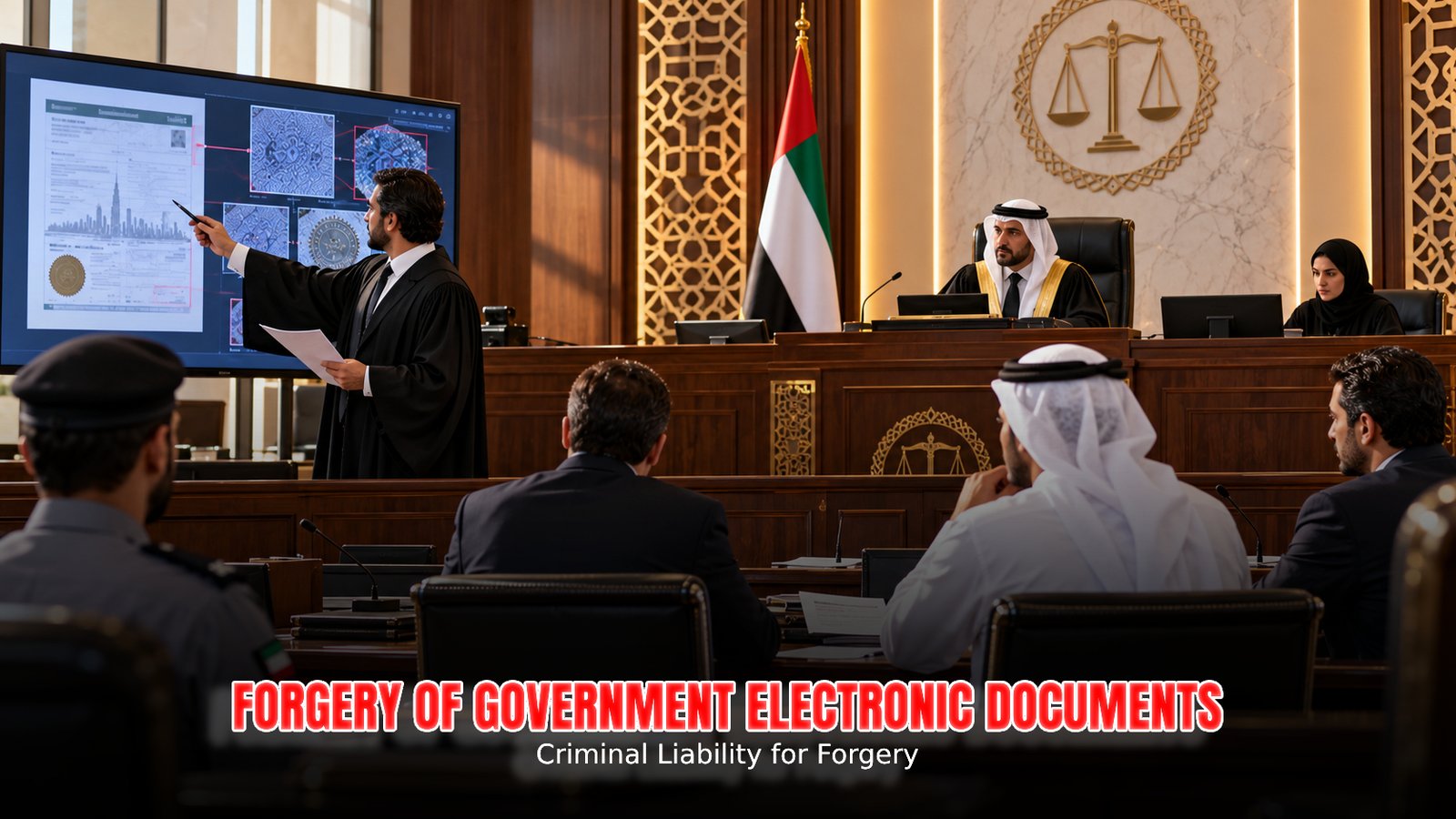
6. Is the Penalty Different for an Electronic Commercial Licence?
Yes. The applicable legal provisions may differ depending on the nature of the document and whether the alleged conduct concerns a paper document or an electronic document belonging to a government authority.
Article 14 of Federal Decree-Law No. 34 of 2021 on Countering Rumours and Cybercrimes addresses the forgery of electronic documents.
Where the forged electronic document belongs to a federal or local government, or a federal or local public authority or entity, the penalty includes temporary imprisonment and a fine ranging from:
AED 150,000 to AED 750,000.
Where the electronic document belongs to an entity outside the categories specified in the first paragraph, the penalty is imprisonment and/or a fine ranging from:
AED 100,000 to AED 300,000.
The same penalty prescribed for the relevant forgery offence applies to anyone who knowingly uses the forged electronic document.
The application of Article 14 must be assessed carefully. Not every alteration to an image of a trade licence stored on a mobile phone automatically falls within the same statutory provision. The nature of the document, the method of forgery and the entity to which it belongs are all relevant.
Where a digital licence is suspected of being manipulated, technical examination may be necessary. This may involve reviewing the electronic file, its source and available technical records, and comparing its details with information held by the competent authority.
7. Criminal Liability of the Main Offender and Accomplices
Criminal responsibility may extend beyond the individual who physically altered or created the forged licence.
Depending on the applicable legal requirements, liability may also arise for individuals who participated in, instigated or assisted the commission of the offence.
Examples of roles that may require investigation include:
- The person who created the counterfeit licence or altered its information.
- An individual who supplied information or documents to facilitate the forgery.
- A person who assisted in using the document while knowing its true nature, where the legal requirements are satisfied.
- An individual who knowingly submitted the forged licence as part of a commercial transaction.
However, criminal responsibility should not automatically be attributed to every shareholder, director or company manager merely because of their professional position or appearance in company records.
The conduct of each individual, their knowledge, their participation and the evidence supporting the allegation must be examined separately.
8. Can a Foreign National Be Deported for Forging a Commercial Licence?
A criminal conviction may result in the deportation of a foreign national where the statutory conditions for judicial deportation are satisfied.
Article 126 of the UAE Crimes and Penalties Law regulates judicial deportation in specified circumstances, including certain cases involving felonies and custodial sentences, subject to applicable exceptions and legal safeguards.
However, it would be inaccurate to state that deportation is mandatory in every commercial licence forgery case without examining:
- The final legal classification of the offence.
- The sentence imposed by the court.
- The applicable deportation provisions.
- Any statutory exceptions that may apply.
It is also important to distinguish judicial deportation ordered by a court from administrative decisions affecting a foreign national’s residence or immigration status. Each has its own legal basis and procedures.
9. Difference Between Commercial Licence Forgery and Operating With an Expired Licence
It is essential to distinguish criminal forgery from regulatory violations relating to the validity or permitted scope of a commercial licence.
| Comparison | Commercial Licence Forgery | Operating With an Expired or Non-Compliant Licence |
|---|---|---|
| Nature of conduct | Altering the truth, fabricating a document or committing another legally defined forgery act | Conducting business without satisfying licensing requirements or after the licence has expired |
| Main legal issue | Whether the elements of forgery or knowing use of a forged document are established | Whether the business has breached the relevant licensing rules |
| Potential penalty | Determined by the document’s classification and the applicable criminal provision | Determined by the relevant regulatory laws and decisions |
| Knowledge of forgery | May be a key element in liability for knowingly using a forged document | The validity of the licence and the conduct of the business are examined |
| Potential consequence | Criminal liability if the offence is established | Regulatory or commercial penalties, with other liability possible depending on the facts |
An expired licence is not automatically a forged licence.
Conversely, a genuine licence may have been validly issued, but presenting an altered copy or using it in a way that changes the truth may raise a separate criminal issue.
10. Investigation and Trial Procedures in Commercial Licence Forgery Cases in Dubai
The procedures depend on the circumstances of each case and the competent authorities. However, an investigation may involve the following stages.
10.1 Filing a Complaint and Collecting Information
A case may begin with a complaint from an affected individual, a government authority or a company that discovers discrepancies between a submitted document and the official licensing records.
It is important to preserve:
- A copy of the suspected document.
- Details of the transaction in which it was used.
- Relevant correspondence.
- Contracts, invoices and payment records.
- Any available official notices or complaint references.
Original electronic files should not be altered or tampered with, as this may affect the integrity of potential evidence.
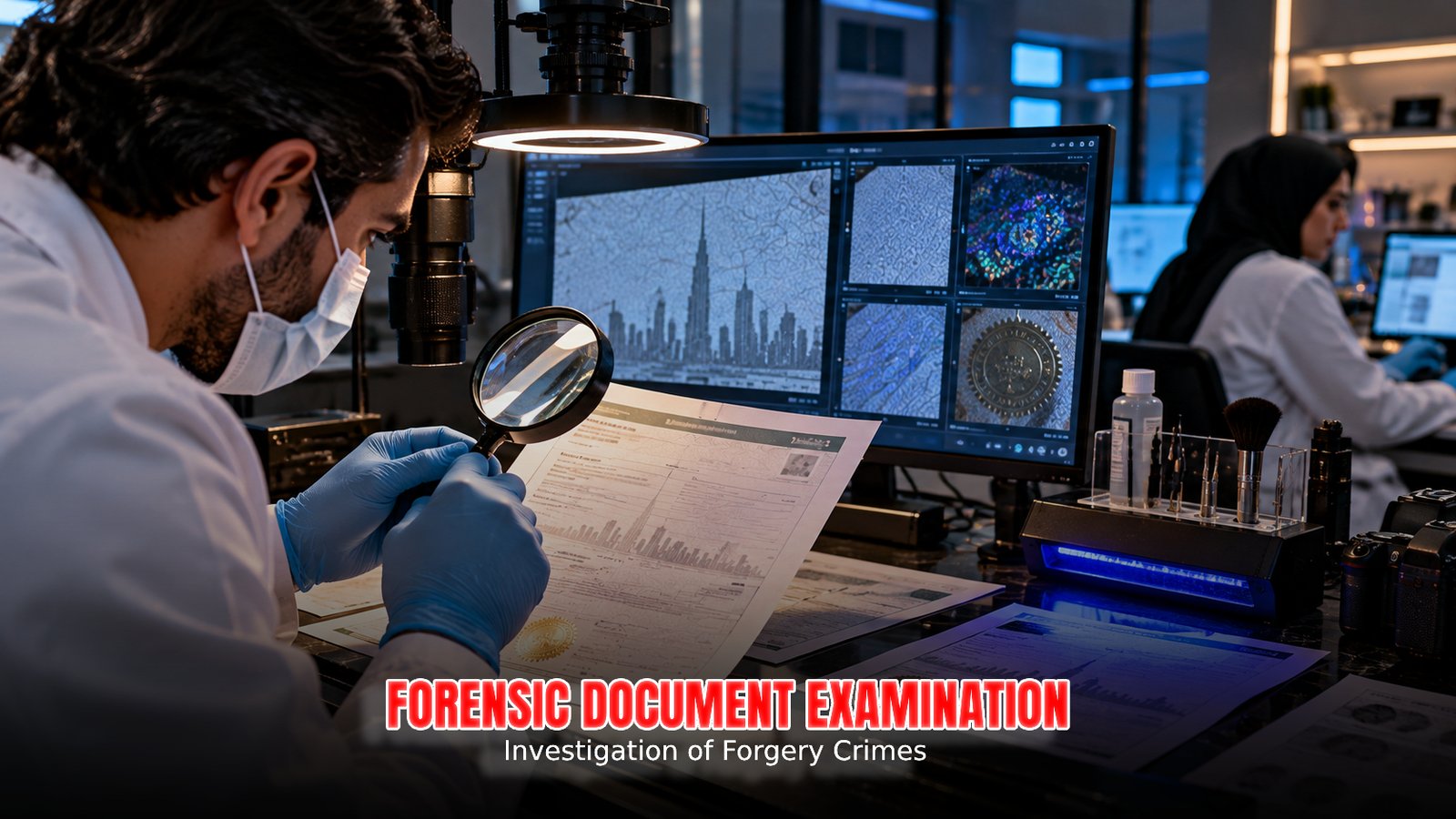
10.2 Technical Examination of the Document
Depending on the nature of the document, investigating authorities may rely on technical expertise to examine signatures, stamps, printed material or electronic files.
The examination may include:
- Comparing the licence details with records held by the issuing authority.
- Reviewing the source of the electronic file.
- Examining available digital records.
- Identifying possible signs of alteration.
A technical report does not automatically establish guilt. All evidence must be evaluated in accordance with the applicable law.
10.3 Investigation by the Public Prosecution
The competent Public Prosecution investigates the reported conduct and determines the appropriate procedures under the law.
This may include hearing statements, requesting technical reports and making decisions concerning pre-trial detention or release in accordance with the applicable legal requirements.
It is not possible to determine in advance that every case will be referred to a particular prosecution department or a specific court. The legal classification, jurisdiction and circumstances of the case are relevant.
10.4 Trial and Judicial Decision
If the case is referred to the competent court, the court examines the prosecution’s evidence, the defence submissions, technical reports and whether the legal elements of the alleged offence have been established.
The court then issues its judgment based on the evidence and applicable law.
11. How Can You Verify the Authenticity of a Commercial Licence in Dubai?
Verifying a commercial licence before signing a contract or transferring money is an important step in reducing the risk of commercial fraud.
11.1 Check Through Dubai’s Department of Economy and Tourism
Businesses and individuals can use the official channels of Dubai’s Department of Economy and Tourism (DET) to check commercial licence information through the available services.
Depending on the service, verification may include reviewing:
- The registered business name.
- The commercial licence number.
- The licence status.
- The registered business activities.
Official website: https://www.dubaidet.gov.ae/
11.2 Verify the Source of the Electronic Document
If a licence contains a QR code or verification link, check that the link leads to an official government domain.
Do not rely solely on the document’s visual appearance or an image sent by another party.
The presence of a QR code is not, by itself, conclusive proof of authenticity. The information returned by the official verification source should be checked and matched against the transaction details.
11.3 Compare Licence Details With the Contract
Before entering into a commercial transaction, compare the company’s registered name, licence number and authorised activities with the information stated in the contract, correspondence and invoices.
Where the transaction involves substantial amounts or ongoing obligations, it may also be appropriate to request additional documents and verify that the company’s representative has the authority to sign.
12. Key Legal Defences in Commercial Licence Forgery Cases
The appropriate defence depends on the case file and available evidence. No particular defence automatically guarantees an acquittal.
However, the following issues may require examination.
12.1 Absence of Knowledge of the Forgery
Where the allegation concerns the use of a forged licence, it may be important to examine whether the accused knew that the document was forged and whether the evidence establishes the required knowledge.
Relevant documents may include:
- A service agreement with an intermediary.
- Correspondence concerning the licence.
- Payment receipts.
- Transaction records.
- Official responses from the issuing authority.
12.2 Failure to Attribute the Forgery to the Accused
The evidence linking the accused to the creation, alteration or use of the document should be examined carefully.
The mere presence of a document in someone’s possession may not, by itself, establish every element of the alleged offence.
12.3 Challenging the Technical Report
The defence may examine the technical methods used, the integrity of the documents or files examined and whether the findings actually connect the accused to the alleged conduct.
Any challenge should be based on specific technical or legal grounds rather than simply disagreeing with the report’s conclusions.
12.4 Challenging the Legality of a Particular Procedure
The legality of arrest, search or the collection of digital evidence may be examined in light of the applicable procedural rules and the circumstances of the case.
It should not be assumed that a procedure is automatically invalid merely because a particular type of warrant is not present. The legal requirements differ according to the procedure and circumstances.
12.5 Absence of the Legal Elements of the Offence
The defence may focus on whether a required element of the relevant statutory provision is missing, whether the document’s actual nature differs from the description in the allegation, or whether the available evidence is insufficient to establish criminal responsibility.
The competent court remains responsible for evaluating the evidence and legal arguments and deciding the case.
Frequently Asked Questions About the Penalty for Forging a Commercial Licence in Dubai
What is the penalty for forging a commercial licence in Dubai in 2026?
If Article 252 of the UAE Crimes and Penalties Law applies to the forgery of an official document, the penalty may reach temporary imprisonment for up to 10 years.
Where the case concerns a copy of an official document or an electronic government document, other provisions may apply depending on the nature of the conduct and the relevant statutory requirements.
Can someone be punished for using a forged licence without creating it?
Yes. A person who knowingly uses a forged document may face criminal liability under Article 258 of the Crimes and Penalties Law or another applicable special provision.
The relevant elements of criminal responsibility, including knowledge where required, must be established.
Is the penalty for forging an electronic commercial licence different from forging a paper licence?
It may be different depending on the nature of the document and the method used to forge it.
The Crimes and Penalties Law or the Countering Rumours and Cybercrimes Law may apply, particularly where the alleged conduct concerns an electronic government document.
The applicable penalty must be determined after examining the specific facts.
Can an accused person be released on bail during an investigation?
Release may be possible subject to the applicable legal requirements and the decision of the competent authority.
However, it is not guaranteed in every case. The nature of the allegation, the circumstances of the case and the legal grounds relating to pre-trial detention may all be considered.
Does a commercial licence forgery offence become time-barred?
Criminal proceedings are subject to the limitation rules under the UAE Criminal Procedures Law.
The applicable period depends on the classification of the offence, relevant statutory exceptions and any procedures that may affect the calculation of time.
A specific limitation period should not be assumed without reviewing the legal classification, the date of the alleged offence and the procedural history.
Can a foreign national be deported after being convicted of commercial licence forgery?
Deportation may follow a conviction where the legal conditions are met.
However, it cannot be assumed to be mandatory in every case without reviewing the type of offence, the sentence and any applicable statutory exceptions.
What is the difference between a forged commercial licence and an expired licence?
Forgery involves conduct that changes the truth of a document in a manner covered by the law.
An expired licence concerns the validity of the commercial authorisation and whether the business is still permitted to operate under it.
Operating with an expired licence may result in regulatory penalties, but it does not automatically constitute forgery.
Do You Need Legal Advice About Commercial Licence Forgery in Dubai?
If you are facing an allegation involving a forged commercial licence, have knowingly or unknowingly used a document suspected of being forged, or have discovered that another party submitted a counterfeit licence, it is important to assess the documents, evidence and applicable legal procedures before taking further action.
Legal Consultant Mohammed Jasem provides legal guidance on UAE commercial and criminal law matters, including the legal assessment of document forgery allegations, review of relevant documents and identification of issues requiring specialised legal attention.
For an initial assessment, prepare the disputed document, transaction details, relevant correspondence and any official notification or complaint reference available.
Contact Legal Consultant Mohammed Jasem for legal guidance on commercial licence forgery and related legal matters in the UAE.
Comments are closed