





Dubai is one of the world’s leading centres for gold and precious metals trading. As a result, importing raw gold into Dubai may form part of a high-value international commercial transaction, particularly where the shipment is intended for a refinery or a company specialising in precious metals processing.
However, the value of the transaction is not the only issue that requires attention. The contract governing the transaction determines who bears the risks associated with the shipment, how the source of the gold is verified, how its weight and purity are established, when the supplier becomes entitled to payment, who is responsible for delays or rejection of the shipment, and what happens if the supplier’s assay differs from the refinery’s results.
For this reason, a raw gold import contract in Dubai should not be treated as an ordinary international sale agreement. It should address the commercial, technical, tax, customs, regulatory, anti-money laundering and compliance aspects of the transaction.
In this article, Legal Consultant Mohammed Jasem explains the key clauses that should be reviewed before signing a raw gold import contract in Dubai and the main risks that should be addressed from the beginning.

What Is Raw Gold or Gold Doré?
Raw gold, commonly referred to as Gold Doré, is semi-refined gold containing gold together with other metals. It normally requires further refining and assay testing to achieve the required purity.
This is important when drafting the contract because the final value of the shipment may not depend solely on its weight. The final price may instead depend on the actual gold content established through testing and refining.
The contract should therefore specify, from the outset:
- Shipment weight.
- Expected purity.
- Other metals contained in the material.
- Sampling method.
- Laboratory or refinery responsible for the assay.
- Method of calculating recoverable gold.
- Pricing mechanism.
- Refining charges and other applicable costs.
What Types of Contracts Are Used to Import Raw Gold into Dubai?
Before drafting the agreement, the parties should determine the actual nature of their commercial relationship because a gold sale agreement is different from a refining agreement.
1. Raw Gold Sale and Purchase Agreement
Under a sale agreement, the supplier agrees to deliver the raw gold to the buyer in exchange for a price determined according to the agreed pricing formula.
The price may be calculated based on:
Quantity of gold × Actual gold content × Agreed reference price
The parties may then deduct refining charges, transportation costs, or other agreed expenses.
2. Toll Refining Agreement
In some transactions, the owner of the gold remains the actual owner while the refinery processes the material in exchange for a refining fee.
In this situation, the agreement should provide detailed provisions concerning:
- Ownership of the gold.
- Weight upon receipt.
- Assay results.
- Recovery percentage.
- Permitted loss.
- Refining charges.
- Ownership of the refined product.
- Refining period.
- The refinery’s liability for unexplained shortages.
A standard sale agreement should not be used where the transaction is actually a toll refining arrangement.
What Are the Essential Clauses in a Raw Gold Import Contract in Dubai?
1. Details of the Parties and Beneficial Owner
The contract should contain the full legal details of each party rather than merely the trading name.
The parties should verify:
- Legal company name.
- Registration number.
- Trade licence.
- Registered address.
- Country of incorporation.
- Authorised signatory.
- Ultimate beneficial owner (UBO).
- Bank account details.
- Relevant business licences.
These details should form part of the due diligence process before the transaction is completed.
2. Description of the Gold
One common drafting mistake is to describe the subject matter simply as “raw gold” without providing sufficient technical details.
Depending on the transaction, the contract should identify:
- Type of gold.
- Number of bars.
- Gross weight.
- Net weight.
- Expected purity.
- Bar numbers.
- Country of origin.
- Source of the gold.
- Shipment number.
- Supporting documents.
It is also advisable to attach a technical schedule describing the shipment and have both parties sign it as part of the contract.
3. Verification of the Source of Gold and Chain of Custody
The source of the gold is one of the most significant legal and compliance risks in the transaction.
The raw gold import contract in Dubai should therefore include representations from the supplier confirming that the gold:
- Was lawfully obtained.
- Does not represent proceeds of crime.
- Is not connected with a sanctioned party.
- Was mined, collected or traded in accordance with applicable laws.
- Has a verifiable source and documented chain of custody.
The buyer or refinery should also have the contractual right to request supporting documents concerning the source of the gold when necessary.
A general certificate from the supplier may not be sufficient. The supporting documents should be capable of being reviewed and verified.
4. Transfer of Ownership
The contract should clearly establish when ownership of the gold passes from the supplier to the buyer.
The parties may agree that ownership passes:
- Upon delivery.
- After completion of the assay.
- After full payment.
- At another agreed contractual milestone.
The agreement should also address:
- The consequences of non-payment.
- The seller’s right to suspend delivery.
- What happens if the shipment is rejected.
- The relationship between transfer of ownership and transfer of risk.
5. Transfer of Risk of Loss
Ownership and risk should not be confused.
For example, ownership may remain with the seller until payment is completed, while the risk associated with the shipment may transfer to the buyer when the goods are handed to the agreed carrier.
The contract should therefore expressly identify the point at which the risk of loss or damage transfers.
If the parties use Incoterms, the agreement should identify the specific Incoterm, its applicable version and the precise delivery location.
6. Weight: How Is the Quantity of Gold Determined?
The contract should establish the method for weighing the shipment rather than leaving the issue to be determined after arrival.
It is advisable to specify:
- Location of weighing.
- Weighing equipment.
- Calibration method.
- Attendance of representatives of both parties.
- Acceptable weight.
- Permitted margin of error.
- Procedure for resolving weight discrepancies.
- Independent authority responsible for resolving disputes.
The contract should also distinguish between gross weight, net weight and the weight attributable to the actual gold content.
7. Assay and Gold Purity Testing
The assay is one of the most critical stages of the transaction because its result may directly affect the value of the gold.
The contract should establish a clear procedure covering:
- Sampling method.
- Number of samples.
- Sample storage.
- Approved laboratory.
- Testing methodology.
- Permitted variance.
- Objection procedure.
- Independent laboratory in case of disagreement.
- Whether the final result is binding on both parties.
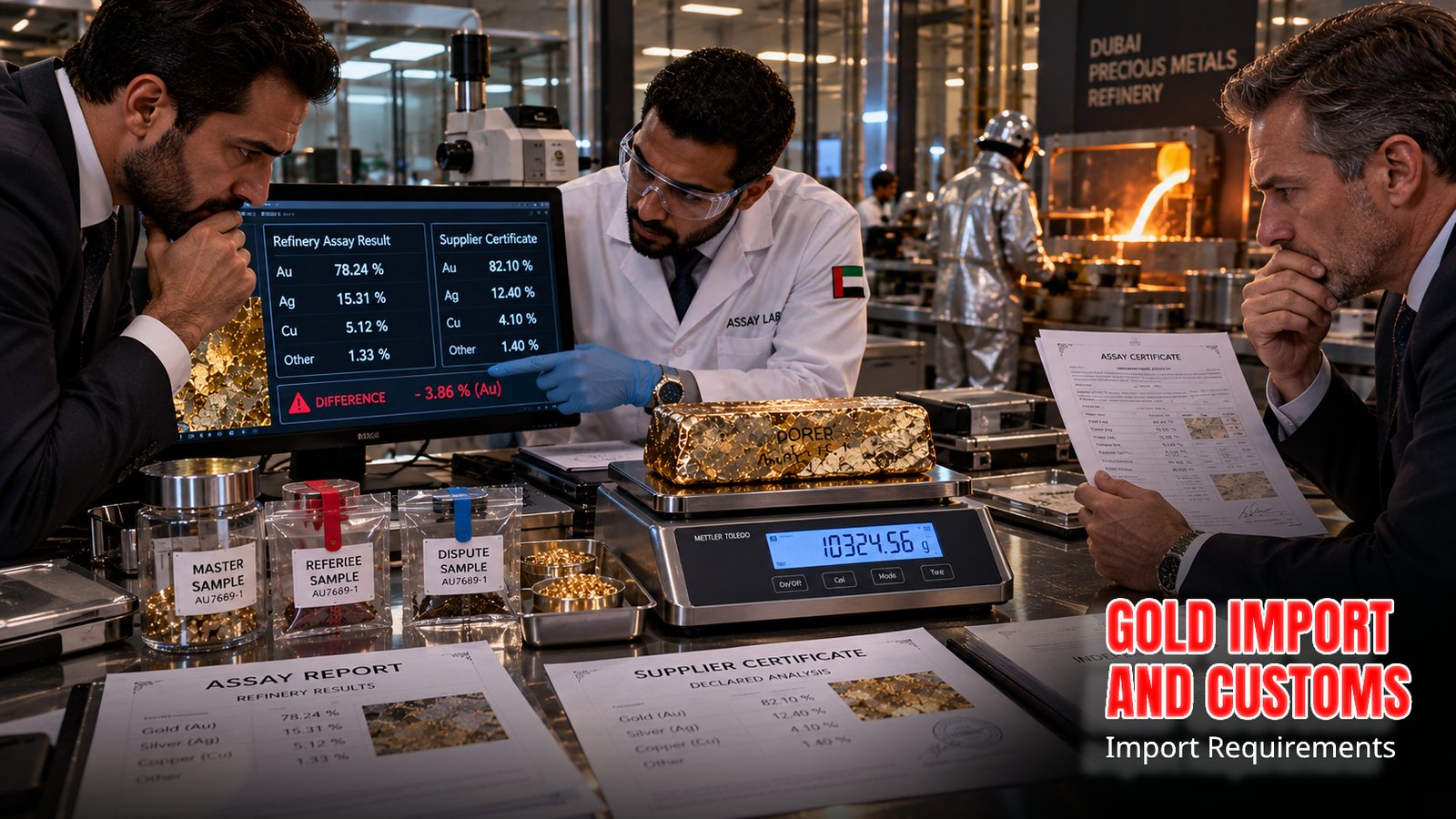
What Happens If the Supplier’s Assay Differs From the Refinery’s Assay?
The contract should preferably require multiple samples and provide for a sealed reserve sample that can be used if a dispute arises.
If the results differ, the reserve sample may be submitted to an independent laboratory agreed upon in advance.
The contract should specify whether the independent laboratory’s result will be final and binding.
This clause is particularly important because the absence of an agreed dispute-testing mechanism may lead to a dispute over the value of the entire shipment.
8. How Is the Price of Raw Gold Determined?
For large international transactions, it is not advisable to rely on a general statement such as:
“The price shall be based on the market price.”
The contract should specify:
- Reference price.
- Price source.
- Pricing date.
- Pricing time, where relevant.
- Currency.
- Exchange rate, where applicable.
- Discount or premium.
- Refining charges.
- Assay costs.
- Permitted loss.
- Method for calculating the final payable amount.
This creates a transparent pricing formula that can be calculated and audited instead of leaving the final price open to further negotiation after the shipment arrives.
9. Payment Terms
One of the most important provisions in a high-value gold transaction concerns the timing and method of payment.
The contract should regulate:
- Amount of any advance payment.
- Payment date.
- Currency.
- Bank account.
- Documents required before payment.
- Effect of the assay result on the price.
- Security arrangements.
- Letters of credit.
- Circumstances allowing payment to be suspended.
For high-value transactions, the parties may consider payment mechanisms that provide greater contractual and banking protection depending on the structure of the transaction.
10. Secure Transportation and Insurance
Raw gold should not be treated as an ordinary commercial shipment.
The contract should specify:
- Security transportation company.
- Party responsible for appointing the carrier.
- Transportation costs.
- Collection point.
- Delivery point.
- Insurance value.
- Insurance beneficiary.
- Responsibility for loss of the shipment.
- Accident reporting procedures.
- Responsibility for transportation delays.
The parties should also ensure that export, import and transportation documents comply with the applicable requirements in the country of origin and the UAE.
11. Documents to Be Provided by the Supplier
The contract should preferably include a clear list of documents that must be provided before or during the transaction.
Depending on the nature of the transaction, these may include:
- Commercial invoice.
- Certificate of origin.
- Export documents.
- Gold source documentation.
- Chain-of-custody records.
- Assay certificate.
- Gold bar details.
- Packing list.
- Transportation documents.
- Insurance documents.
- Corporate documents.
- Beneficial ownership information.
- Tax documents.
- Required licences and permits.
The agreement should also specify the consequences of failing to provide any material document.
12. Anti-Money Laundering Clause
Gold transactions require strong compliance provisions, particularly because precious metals transactions can present elevated money laundering risks.
The contract should regulate the parties’ obligations concerning:
- Know Your Customer (KYC).
- Beneficial ownership verification.
- Source of funds.
- Source of gold.
- Sanctions screening.
- Supporting documentation.
- Cooperation with compliance requests.
- Suspension of the transaction where a legal restriction arises.
The applicable UAE legal and regulatory framework should also be reviewed at the time the contract is signed rather than relying on an outdated agreement template.
13. Responsible Gold Sourcing
Compliance should not be limited to anti-money laundering requirements.
The buyer or refinery may also require information concerning the gold supply chain, its origin and the associated sourcing risks.
The contract may therefore require the supplier to provide information enabling the other party to conduct appropriate due diligence concerning responsible sourcing.
The buyer or refinery may also be given the contractual right to:
- Request additional documents.
- Review information provided by the supplier.
- Suspend the transaction.
- Reject the shipment where its source cannot be adequately established.
14. What Happens If the Bank Rejects the Transfer?
This possibility should be addressed in the contract rather than treated as an unexpected event.
A bank may request additional documents or suspend a transfer as part of its compliance procedures.
The contract should therefore establish:
- Whether the buyer may suspend payment.
- Whether an alternative bank may be used.
- The maximum suspension period.
- When either party may terminate the contract.
- Responsibility for banking charges.
- What happens to the gold while it is held by the buyer or carrier.
15. VAT on Gold
A common drafting mistake is to insert a general statement such as:
“VAT on raw gold is 5%.”
The applicable VAT treatment depends on the nature of the gold, the supply and whether the conditions for a particular VAT treatment are satisfied.
Certain qualifying investment precious metals, including gold meeting the applicable purity and trading requirements, may qualify for zero-rating, while other rules may apply to certain supplies and transactions between VAT-registered persons.
The contract should therefore identify:
- The party responsible for VAT.
- The agreed tax treatment.
- Required tax documents.
- Tax registration details.
- Reverse-charge mechanism where applicable.
- Responsibility for penalties or liabilities arising from either party’s error.
16. Customs and Clearance
The contract should identify the party responsible for import procedures and customs clearance.
This should include:
- Official importer.
- Customs broker.
- Required documents.
- Customs duties and fees.
- Other expenses.
- Customs inspection.
- Delays.
- Refusal of clearance.
- Liability for inaccurate declarations.
The existence of a customs relief, exemption or preferential treatment for a particular product does not eliminate the need to comply with applicable declaration and customs procedures.
17. Force Majeure
The contract should address circumstances beyond the parties’ reasonable control, including:
- War.
- Border closures.
- Government restrictions.
- Natural disasters.
- Airport closures.
- New sanctions.
- Restrictions on financial transfers.
However, the agreement should also clarify whether the supplier’s failure to obtain a required licence or document constitutes force majeure or a contractual breach.
18. Breach of Contract and Remedies
The legal consequences of breach should be established clearly rather than left to future disputes.
The contract may address:
- Shipping delays.
- Weight shortages.
- Lower-than-agreed purity.
- Failure to provide documents.
- Compliance violations.
- Non-payment.
- False information.
- Breach of gold-source requirements.
Depending on the agreement, the affected party may have the right to:
- Reject the shipment.
- Request replacement.
- Request a price reduction.
- Suspend performance.
- Terminate the contract.
- Claim compensation.
19. Governing Law
Because raw gold imports into Dubai are often international transactions, the governing law should be expressly identified.
The parties should avoid general wording such as:
“This agreement shall be governed by applicable laws.”
Instead, the contract should clearly identify the chosen governing law and explain how it applies to the agreement.
20. Arbitration and Dispute Resolution
The parties may agree to commercial arbitration for resolving disputes, particularly in international gold transactions.
An arbitration clause should clearly establish, as applicable:
- Seat of arbitration.
- Arbitration rules.
- Number of arbitrators.
- Appointment procedure.
- Arbitration language.
- Governing law.
- Scope of disputes covered by the arbitration agreement.
The parties may also agree to negotiation or mediation before arbitration, provided that the contract establishes a clear time period for that stage.
What Are the Most Common Mistakes in Raw Gold Import Contracts?
Several seemingly minor mistakes can result in significant financial losses.
Common examples include:
- Paying the full value before verifying the gold.
- Failing to verify the supplier and beneficial owner.
- Failing to establish the source of the gold.
- Failing to specify the sampling method.
- Failing to retain a sealed arbitration sample.
- Failing to identify the independent laboratory.
- Confusing transfer of ownership with transfer of risk.
- Failing to establish a clear pricing formula.
- Ignoring tax considerations.
- Failing to address a bank’s refusal to process a transfer.
- Failing to allocate transportation and insurance responsibilities.
- Using an unclear arbitration clause.

Raw Gold Import Contract Checklist for Dubai
Before signing the contract, ask the following questions.
About the Supplier
- Is the company properly established and licensed?
- Who is the beneficial owner?
- Has sanctions screening been completed?
- Is the source of the gold clear?
About the Gold
- What is the weight?
- What is the purity?
- What is the country of origin?
- What supporting documents are available?
About the Assay
- Who will conduct the assay?
- What is the sampling method?
- Is there a sealed reserve sample?
- Who resolves a disagreement between assay results?
About the Price
- What is the reference price?
- When is the price determined?
- What discounts apply?
- What are the refining charges?
About Payment
- When does payment become due?
- Is security required?
- Is there a letter of credit?
- What happens if the bank rejects the transfer?
About Shipping
- Who bears the risk?
- Who provides insurance?
- Who contracts with the secure carrier?
- Where does delivery take place?
About Compliance
- Has KYC been completed?
- Has the source of gold been verified?
- Are chain-of-custody documents available?
- Is the transaction consistent with banking and regulatory requirements?
About Disputes
- What law governs the contract?
- Will disputes be resolved through the courts or arbitration?
- What is the seat of arbitration?
- What language will be used in the proceedings?
Do You Need a Lawyer to Review a Raw Gold Import Contract?
Raw gold contracts are different from ordinary commercial sale agreements because they combine commercial, technical, tax, customs, anti-money laundering, responsible sourcing and international dispute-resolution issues.
Reviewing the agreement before transferring funds or shipping the gold can help identify risks concerning:
- Price.
- Ownership.
- Assay.
- Payment.
- Source of gold.
- Compliance.
- Transportation.
- Insurance.
- Customs.
- Tax obligations.
- Dispute resolution.
Legal Consultant Mohammed Jasem provides legal services to companies and investors in the UAE, including the review and drafting of international commercial contracts, contractual risk assessment, payment and security provisions, and dispute-resolution clauses tailored to the structure of the transaction.
Conclusion
The success of a raw gold import transaction into Dubai does not depend solely on the shipment reaching the UAE. It also depends on having a clear contract that regulates every important stage before and after the gold arrives.
The contract should expressly address the source of the gold, ownership, weight, assay, pricing, payment, transportation, insurance, customs, taxation, anti-money laundering compliance, responsible sourcing, governing law and dispute resolution.
The larger and more complex the transaction, the more important precise contractual drafting becomes. Resolving a dispute after the shipment arrives can be considerably more expensive and difficult than preventing the dispute through careful contract drafting from the beginning.
If you are preparing to sign a contract for the import of raw gold into Dubai, obtaining a legal and regulatory review before committing to the transaction can help clarify the obligations, risks and rights of each party.
Frequently Asked Questions
What Should a Raw Gold Import Contract in Dubai Include?
The contract should identify the parties, describe the gold, specify weight and purity, establish the source of the gold, define the assay procedure, pricing formula, payment terms, transfer of ownership and risk, shipping and insurance arrangements, taxation, compliance, governing law and dispute resolution.
How Is the Price of Raw Gold Determined?
The price is commonly calculated using a formula linked to the actual gold content, assay results and an agreed reference price, together with applicable discounts, costs, refining charges and permitted losses.
What Happens If the Gold Assay Results Differ?
The parties should follow the assay dispute mechanism specified in the contract. This may include using a sealed reserve sample and submitting it to an independent laboratory agreed upon in advance.
Must the Source of Gold Be Verified Before Import?
The source of the gold and the documents establishing its chain of custody should be verified according to the nature of the transaction and applicable regulatory requirements, particularly where due diligence and responsible sourcing obligations apply.
Is Raw Gold Subject to VAT in the UAE?
The VAT treatment depends on the nature of the gold, the supply and whether the relevant conditions for a particular VAT treatment are satisfied. The applicable tax treatment should therefore be reviewed before the contract is finalised.
Can Arbitration Be Used in a Raw Gold Import Contract?
Yes. The parties may agree to arbitration, but the arbitration clause should clearly identify the seat, rules, procedures, language and governing law as appropriate.
How Can a Foreign Supplier Protect Its Right to Payment?
Payment protection may be structured through payment terms, security arrangements and letters of credit, with certain payment stages linked to documents, assay results and other contractual requirements.
Legal Disclaimer
This article is provided for general legal information and educational purposes only and does not constitute legal advice regarding a specific transaction or contract. UAE laws, regulations and regulatory decisions may change, and the applicable legal and tax treatment may depend on the facts, documents and structure of each transaction. The applicable laws and regulatory requirements should therefore be reviewed before taking action or entering into a raw gold import transaction.
Comments are closed