





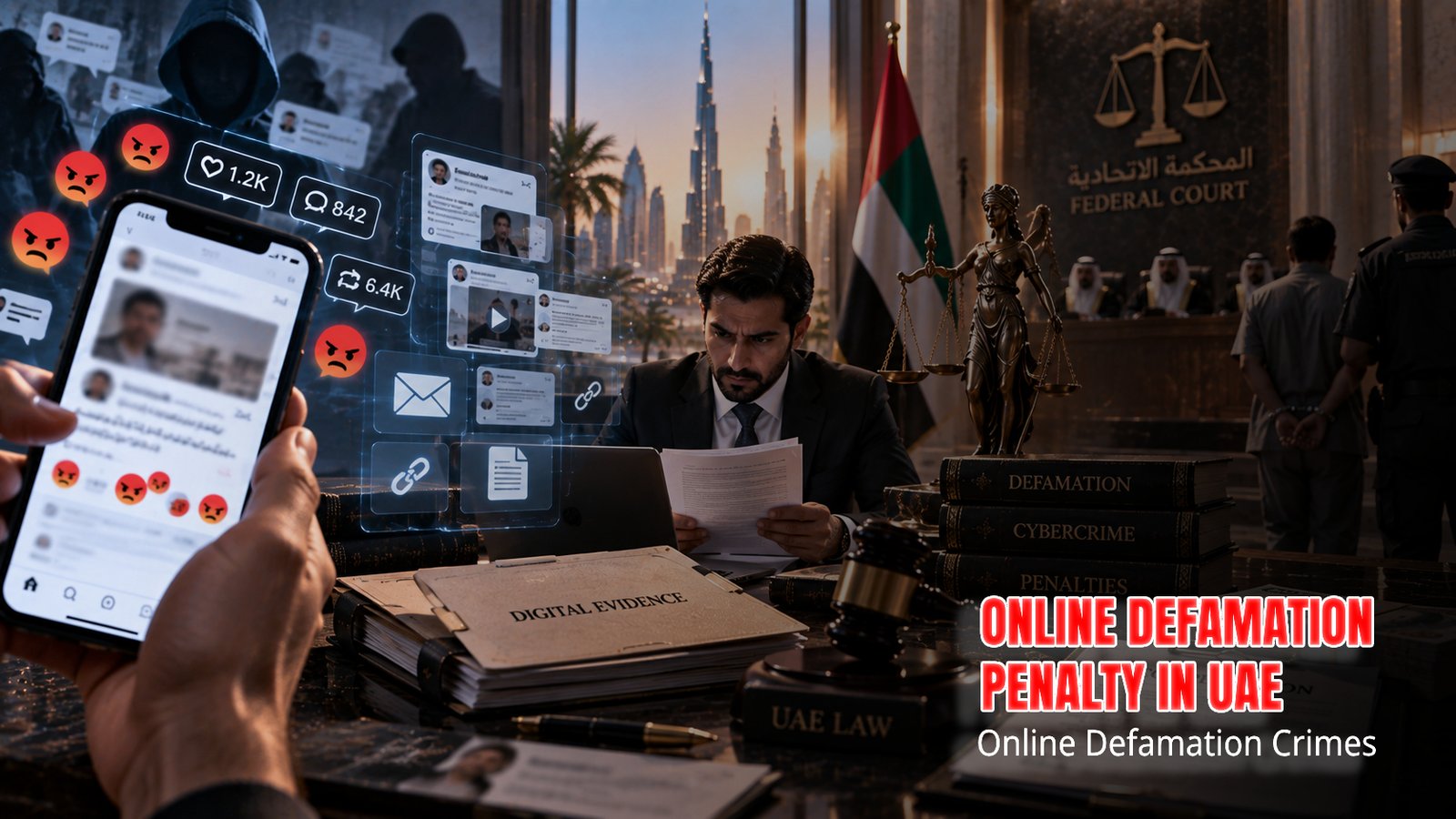
Defamation in the United Arab Emirates can result in criminal liability, particularly where a person publishes allegations or statements that harm another person’s reputation, honour or dignity. With the rapid growth of social media and digital communication, online defamation in the UAE has become an increasingly important legal issue requiring careful attention.
Defamation is not limited to newspaper articles or public statements. Depending on the circumstances, legal liability may arise from a social media post, email, comment, video, message or other content published through information technology.
UAE legislation addresses these acts through the UAE Crimes and Penalties Law and legislation regulating cybercrimes and the misuse of information technology. The applicable offence and penalty depend on the nature of the statement, the method of publication, the circumstances of the incident, the identity or status of the victim and the available evidence.
What Is Defamation Under UAE Law?
Defamation may take different forms. In general terms, legal responsibility may arise when statements, allegations or other content are published or attributed to a person in a manner capable of harming that person’s reputation, honour or dignity.
However, not every offensive statement automatically constitutes defamation. The legal classification depends on the facts and evidence of each case.
Defamation-related conduct may occur through:
- Social media platforms
- Newspapers and publications
- Websites
- Blogs
- Emails
- Digital applications
- Video content
- Public comments and posts
- Certain forms of electronic communication or private messages, depending on the circumstances
Deleting a post after publication does not necessarily eliminate potential legal responsibility, particularly if the content has already been saved, captured, shared or otherwise documented.
What Are the UAE Defamation Laws?
Defamation, insult and related offences may be governed by more than one UAE law. Two important legislative frameworks are the Federal Decree-Law No. 31 of 2021 on the Crimes and Penalties Law and Federal Decree-Law No. 34 of 2021 on Combating Rumours and Cybercrimes.
Federal Decree-Law No. 31 of 2021
The UAE Crimes and Penalties Law contains provisions addressing offences affecting reputation, including defamation and insult.
Article 425: Defamation
Article 425 provides for imprisonment for a period not exceeding two years or a fine not exceeding AED 20,000 for a person who, through a means of publicity, attributes to another person an incident that could make that person subject to punishment or contempt.
Article 426: Insult
Article 426 addresses insulting conduct that affects a person’s honour or dignity without attributing a specific incident to that person. The provision provides for imprisonment for a period not exceeding one year or a fine not exceeding AED 20,000, subject to the circumstances and any applicable aggravating factors.
The applicable penalty therefore depends on the exact nature of the conduct and the legal provision applicable to the specific circumstances.
What Is the Penalty for Defamation in the UAE?
There is no single penalty that applies to every defamation case in the UAE.
The consequences may vary depending on factors including:
- The nature of the statement or published content
- Whether a specific allegation was attributed to the victim
- Whether the statement was insulting or defamatory
- The method used to publish the content
- Whether the publication was public
- Whether information technology was used
- The status of the victim
- Whether aggravating circumstances exist
- The evidence available in the case
For this reason, it would be inaccurate to assume that every defamation case automatically results in the same fine or prison sentence.
What Is the Penalty for Online Defamation in the UAE?
Online defamation in the UAE is particularly important because digital content can spread rapidly and reach a large audience.
Federal Decree-Law No. 34 of 2021 on Combating Rumours and Cybercrimes contains specific provisions dealing with offences committed through information networks and information technology.
Under Article 43, a person who uses an information network, information technology means or an information system to insult another person or attribute to that person an incident that could make them subject to punishment or contempt may face imprisonment and/or a fine ranging from AED 250,000 to AED 500,000.
The law also provides for stricter treatment in certain circumstances, including cases involving public officials or persons entrusted with public service when the offence is committed during, because of, or on the occasion of performing their duties.
Can an Instagram, Facebook or TikTok Post Constitute Defamation?
Yes. Social media posts, comments, videos and other digital content may fall within the scope of cybercrime legislation if the legal elements of the offence are established.
The fact that the account is personal or has a limited number of followers does not automatically exclude legal responsibility.
The important considerations include the content, the method of publication, the circumstances and the applicable legal provision.
Can Reposting Defamatory Content Create Legal Liability?
Potentially, yes.
A person should not assume that they are automatically protected simply because someone else originally created the defamatory content.
Sharing or reposting content containing potentially unlawful allegations may create legal consequences depending on the circumstances.
Particular caution should be exercised when:
- Reposting offensive publications
- Sharing defamatory videos
- Adding comments supporting allegations
- Publishing private photographs or conversations with the intention of causing harm
- Circulating unverified accusations
- Publishing personal information with the intention of damaging someone’s reputation
Before sharing potentially harmful content, it is important to consider whether the content is accurate, lawful and necessary to publish.
What Is the Difference Between Defamation, Libel and Insult in the UAE?
Understanding the distinction between different forms of reputation-related offences is important.
Defamation
Defamation generally involves attributing a specific incident or allegation to another person where the allegation could expose that person to punishment or contempt.
Article 425 of the UAE Crimes and Penalties Law addresses this form of conduct.
Insult
Insult generally concerns statements or expressions that affect a person’s honour or dignity without necessarily attributing a specific incident to them.
Article 426 addresses this form of conduct.
Online Defamation
Where the conduct is committed through an information network or information technology, the provisions of the UAE cybercrime legislation may become applicable, including Article 43 of Federal Decree-Law No. 34 of 2021.
Is Defamation a Criminal or Civil Matter in the UAE?
A defamation incident may result in criminal liability, and depending on the circumstances, the affected person may also have grounds to pursue civil compensation.
These are two distinct legal aspects.
Criminal Liability
Criminal proceedings concern whether the conduct constitutes an offence under the applicable UAE criminal legislation and whether the required elements of the offence can be established.
Civil Compensation
A person who suffers damage may potentially seek compensation where the requirements of civil liability are satisfied and the damage and its connection to the unlawful conduct can be established.
The existence of a criminal case does not automatically determine every aspect of a civil compensation claim. Each claim must be assessed according to its own legal requirements and evidence.
What Evidence Is Required in a UAE Defamation Case?
Evidence is particularly important in defamation cases, especially where the alleged offence occurred online.
Depending on the circumstances, relevant evidence may include:
- Screenshots
- Post URLs
- Emails
- WhatsApp or other electronic messages
- Videos
- Lawfully obtained recordings
- Account information
- Publication dates and times
- Usernames
- Comments and reposts
- Documents establishing damage
- Relevant transaction or payment records
- Other electronic records and supporting documents
However, a screenshot alone does not automatically establish a criminal offence.
The evidentiary value of the material, how it was obtained, whether it remains reliable and whether it can properly be attributed to the accused may all be examined during an investigation or court proceedings.
What Should You Do If You Are a Victim of Online Defamation in the UAE?
If someone has published defamatory content about you online, it is generally important to avoid reacting emotionally or publishing retaliatory statements.
Practical steps may include:
1. Preserve the Evidence
Save the original post, message or video and record the URL, username, date and time whenever possible.
2. Avoid an Online Argument
Responding with insults, accusations or threatening statements may create a separate legal issue.
3. Preserve the Original Material
Do not rely on a single screenshot if other relevant information is available. Preserve the original links, messages and files whenever possible.
4. Seek Legal Advice
A lawyer can assess whether the content may constitute defamation, insult, an online offence or another legally actionable act.
5. Take the Appropriate Legal Action
The appropriate procedure depends on the circumstances, the location of the offence, the identity of the person responsible, the platform used and the nature of the content.
Does Deleting a Defamatory Post Cancel the Offence?
Not necessarily.
Deleting content after publication does not automatically mean that the legal consequences disappear.
The content may already have been:
- Screenshot
- Saved
- Reposted
- Sent to other people
- Archived electronically
- Submitted to the authorities
For this reason, deleting the original post should not be treated as an automatic way to eliminate potential legal responsibility.
Is Defamation on WhatsApp a Crime in the UAE?
Messages or content sent through communication applications may be subject to applicable UAE laws depending on the nature of the statement, the circumstances of the communication, the recipients and the applicable legal provision.
The fact that a message was sent through a private conversation does not automatically make every statement legally permissible.
The exact legal position requires an examination of the message, the context, how it was transmitted and the available evidence.
Is Publishing an Unproven Accusation Defamation?
Publishing an unproven accusation may create legal liability where the required legal elements are established.
A key distinction should be made between:
A lawful expression of opinion
and
Attributing a specific allegation to another person in a manner capable of damaging their reputation or exposing them to contempt or punishment.
Simply claiming that a statement is “the truth” does not automatically prevent legal liability. The assessment depends on the nature of the allegation, the manner in which it was expressed, the evidence and the applicable legislation.
Is Criticising a Person or Company Defamation?
Not every criticism constitutes defamation.
A person may, depending on the circumstances, express an opinion or describe a genuine experience. However, the situation may become legally problematic where the content contains false allegations, insulting statements or accusations capable of unlawfully harming another person’s reputation.
It is therefore important to distinguish between:
- Opinion
- Criticism
- A complaint
- A legitimate warning
- An allegation
- Defamation
- Insult
- Online defamation
The final legal classification depends on the content, context and available evidence.
Can You File a Defamation Case Over a Social Media Post?
Yes, legal proceedings may be available where the required elements of an offence or civil claim are established.
Defamation-related incidents may arise on platforms such as:
- TikTok
- X
- YouTube
- Telegram
- Websites and online forums
However, the existence of an offensive post does not automatically guarantee a conviction. The prosecution must establish the applicable legal elements and, where required, connect the conduct to the accused person.
What If the Defamatory Account Is Anonymous?
An anonymous account does not necessarily make legal action impossible.
In cybercrime cases, digital information may assist the authorities in identifying the person behind an account, subject to the available evidence and applicable legal procedures.
For this reason, victims should preserve:
- Account usernames
- Profile links
- Post URLs
- Screenshots
- Messages
- Publication dates
- Other identifying digital information
before content disappears or changes.
Can Artificial Intelligence Lead to Defamation Liability?
The rapid development of artificial intelligence has created new forms of potentially harmful digital content, including:
- Fake images
- Manipulated videos
- AI-generated voices
- Fabricated statements
- False content attributed to another person
- Impersonation accounts
Such conduct may raise several legal issues, including defamation, privacy violations, impersonation and cybercrime, depending on the circumstances.
Using artificial intelligence does not automatically provide immunity from legal responsibility.

Can a Victim Claim Compensation for Defamation in the UAE?
Potentially, yes.
A person affected by defamatory conduct may be able to seek compensation where the applicable requirements of civil liability are satisfied and the damage and causal connection to the unlawful conduct can be established.
Depending on the circumstances, claimed damages may include:
- Moral damage
- Harm to reputation
- Financial losses
- Business-related losses
- Professional damage
The claimant must satisfy the applicable legal and procedural requirements for establishing the damage and its connection to the conduct.
What If the Defamation Targets a Company or Brand?
Companies and businesses can also suffer significant harm from false or damaging statements published about their business, products or services.
Depending on the circumstances, the matter may involve issues relating to:
- Corporate reputation
- Commercial interests
- Trademarks
- Competition
- Confidential business information
- Digital content
- Compensation for damage
The applicable legal provisions should be determined according to the facts rather than assuming that every business-related dispute constitutes defamation alone.
Can an Accused Person Defend Against a Defamation Charge?
Yes.
An accused person has the right to defend themselves in accordance with applicable UAE legal procedures.
Depending on the circumstances, a defence may examine issues such as:
- Whether the accused actually committed the act
- Whether the account or publication can be attributed to the accused
- Whether all elements of the alleged offence are established
- The exact nature of the statements
- The context in which the content was published
- The authenticity and integrity of the evidence
- How the evidence was obtained
- Whether the evidence is sufficient
- Whether the statements constituted an opinion rather than an allegation of fact
- Any other applicable legal defence
The strength of any defence cannot be determined without reviewing the original facts and evidence.
How Can a Lawyer Help With a Defamation Case in the UAE?
Legal assistance generally begins with a detailed review of the incident, the content involved and the manner in which it was published.
A lawyer may assist with:
Content Analysis
Determining whether the content may constitute defamation, insult, an online offence or another actionable offence.
Digital Evidence Analysis
Reviewing screenshots, links, messages, account information and other available digital evidence.
Identifying the Appropriate Legal Procedure
Assessing the competent authorities and appropriate legal steps based on the circumstances of the case.
Preparing Complaints and Legal Submissions
Preparing legal documents and submissions based on the facts and available evidence.
Defending an Accused Person
Where an individual is accused of defamation, a lawyer can review the evidence, assess the legal classification and develop the appropriate defence strategy.

How Can You Avoid Defamation Liability in the UAE?
The safest approach is to think carefully before publishing allegations, particularly on platforms where content can spread rapidly.
Before publishing a potentially damaging statement, ask:
- Do I have reliable evidence supporting the allegation?
- Is the information accurate?
- Is publication necessary?
- Could the statement damage someone’s reputation?
- Can I communicate the issue in a more neutral way?
- Am I using insulting language?
- Am I sharing information originally published by someone else without verifying it?
Most importantly:
Do not repost an allegation simply because someone else published it first.
Reposting potentially unlawful content may itself create legal risks depending on the circumstances.
Do UAE Defamation Laws Apply to Foreigners?
UAE laws may apply to persons present in the UAE according to the applicable jurisdiction, the circumstances of the offence and the relevant legal framework.
Residents, visitors, business owners and professionals should therefore exercise caution when publishing content through social media or other digital platforms in the UAE.
Important Legal Tips for Online Defamation Cases
If you are involved in a defamation dispute in the UAE, consider the following:
- Preserve evidence before deleting anything.
- Do not respond with insults or threats.
- Avoid publishing additional details that could create further legal exposure.
- Keep original links, messages and files.
- Record publication dates and times.
- Do not alter original digital files.
- Do not repost the allegedly defamatory content.
- Seek legal advice before taking significant action.
- Do not assume that deleting a post automatically ends liability.
- Consider whether a civil compensation claim may also be available.
Frequently Asked Questions
What is the penalty for defamation in the UAE?
The penalty depends on the nature of the conduct and the applicable legal provision. Under Article 425 of the UAE Crimes and Penalties Law, the penalty may reach imprisonment for up to two years or a fine of up to AED 20,000 in the circumstances specified by that provision.
What is the penalty for online defamation in the UAE?
Under Article 43 of Federal Decree-Law No. 34 of 2021, the specified online defamation conduct may be punishable by imprisonment and/or a fine ranging from AED 250,000 to AED 500,000.
Is insulting someone on WhatsApp a crime in the UAE?
Content sent through WhatsApp or other communication platforms may result in legal liability depending on the nature of the content, the circumstances and the applicable legal provision.
Can I file a case because of an Instagram post?
Yes, legal action may be available if the elements of the relevant offence or civil claim are established.
Does deleting a defamatory post prevent legal action?
No. Deleting a post does not automatically eliminate potential liability, particularly where the content has already been documented, shared or preserved.
Can I claim compensation for defamation?
Potentially. A person who suffers legally recognised damage may be able to pursue compensation if the relevant civil liability requirements are established.
Is every negative review or criticism defamation?
No. Lawful criticism or an honest opinion is not automatically defamation. The legal assessment depends on the exact wording, context and circumstances.
Can reposting defamatory content create liability?
Potentially. Reposting or sharing content may create legal consequences depending on the nature of the content and the circumstances in which it was shared.
Conclusion
The UAE takes offences affecting reputation, honour and dignity seriously, and these issues have become increasingly important in the digital age, where information can spread to a large audience within seconds.
Social media should not be treated as a space free from legal responsibility. Content published or transmitted through digital platforms may fall within the scope of Federal Decree-Law No. 34 of 2021 on Combating Rumours and Cybercrimes, including Article 43, while the UAE Crimes and Penalties Law addresses other forms of defamation and insult.
At the same time, the existence of an offensive post does not automatically establish criminal liability. Each case requires careful examination of the content, context, digital evidence, identity of the publisher, method of publication and applicable legal provisions.
Whether you are a victim of defamation or accused of defamation in the UAE, obtaining professional legal advice at an early stage can help preserve evidence, identify the appropriate legal procedure and protect your rights before taking any step that could affect the case.
Comments are closed