




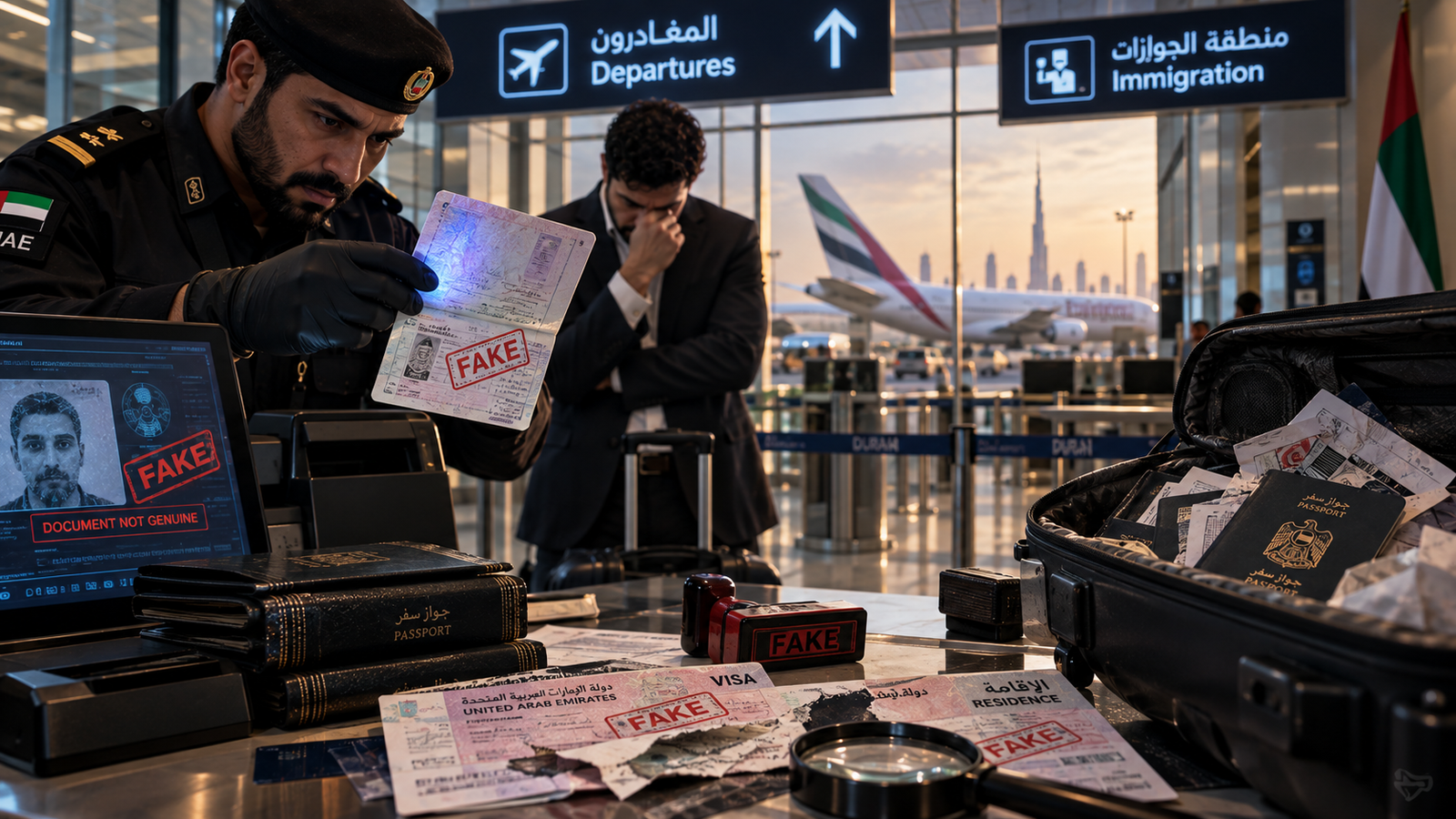
Using forged travel documents in the United Arab Emirates (UAE) is a serious matter that may result in criminal liability, particularly when the document involves a forged visa, residence permit, passport, or official document used to obtain a visa or residency.
Criminal liability does not necessarily apply only to the person who created or forged the document. It may also extend to a person who knowingly uses a forged document.
This issue is particularly important at UAE airports and points of entry and exit, where travel documents, visas, and passenger information are subject to verification and inspection by the competent authorities.
Under Federal Decree-Law No. (29) of 2021 on the Entry and Residence of Foreigners, Article 24 provides for imprisonment of up to 10 years for forging a visa, residence permit, or official document upon which the issuance of such visas or permits is based, when done with the intention of circumventing the provisions of the law.
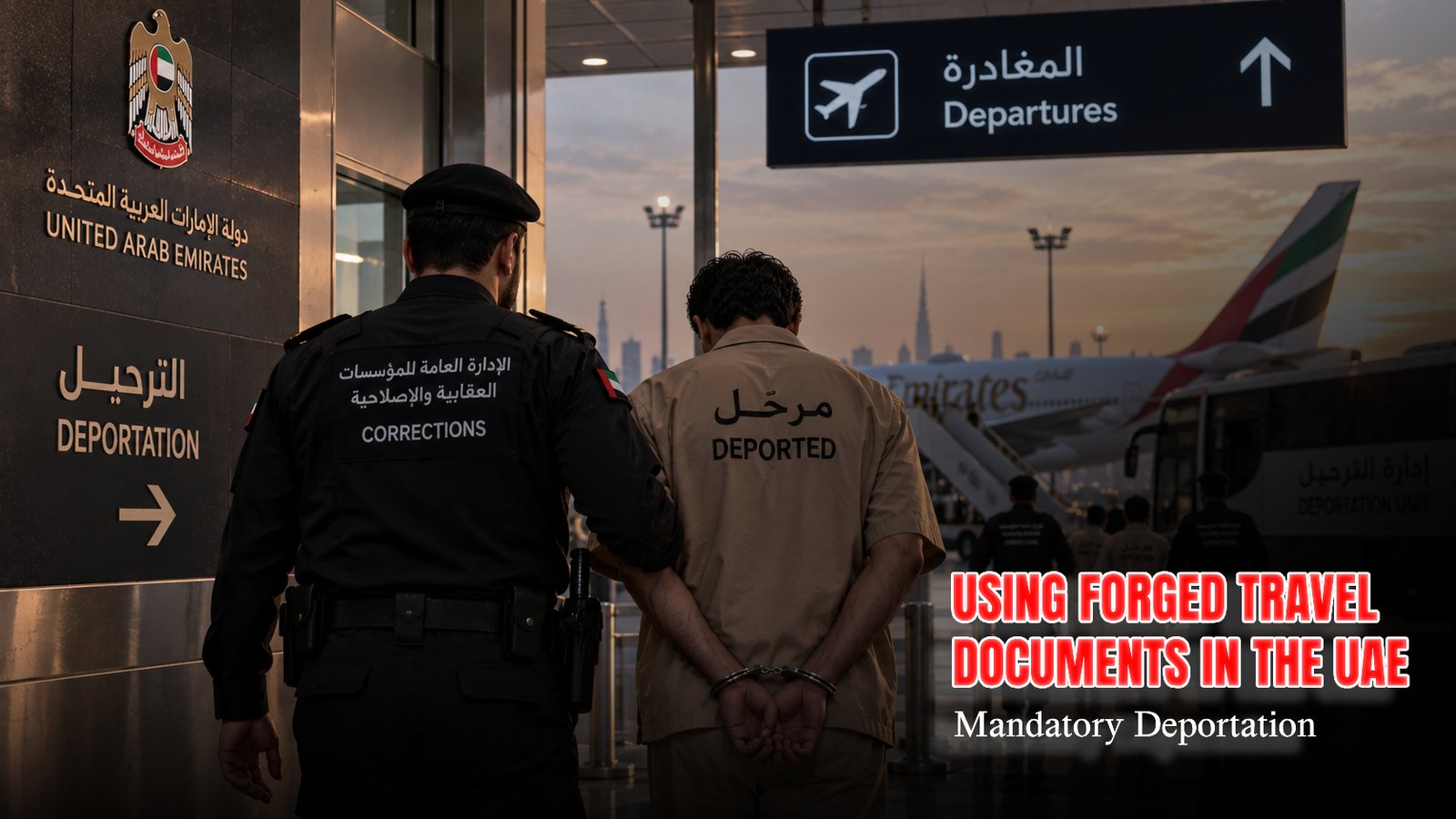
The same penalty may apply to a person who knowingly uses such forged documents. Importantly, Article 24 also provides that the court shall order the deportation of the foreigner in all cases falling under the provision.
Legal Disclaimer: The applicable liability and penalty depend on the circumstances of each case, the nature of the document, the person’s knowledge of the forgery, the available evidence, and the specific legal provisions applicable to the facts.
What Is the Legal Position on Using a Forged Travel Document in the UAE?
One of the most important questions is:
Can a person be punished for using a forged document even if they did not create or forge it themselves?
Yes. Criminal liability may arise even when the user was not the person who created the forged document.
Article 24 of the UAE Entry and Residence of Foreigners Law distinguishes between forging a visa or residence permit and knowingly using a forged document, and provides for the same penalty in the latter situation.
The UAE Crimes and Penalties Law also contains a general provision concerning the use of forged documents. Article 258 provides that a person who uses a forged document knowing that it is forged may be subject to the penalty prescribed for the underlying forgery offence, depending on the circumstances.
This makes the element of knowledge particularly important. Merely possessing an incorrect or invalid document does not, by itself, answer every legal question. The authorities and courts may examine the circumstances and evidence surrounding the document and its use.
Is Using a Forged Visa a Crime in the UAE If a Travel Agent Provided It?
This is one of the most common practical questions.
A person may obtain a visa through a travel agency, intermediary, or individual claiming to provide visa services and later discover that the document is not genuine.
In such circumstances, it is important to distinguish between two situations.
The First Situation: Knowledge of the Forgery
If a person knew that the visa was forged and nevertheless used it, criminal liability may arise under the applicable UAE laws.
The Second Situation: No Knowledge of the Forgery
If a person genuinely believed that the document was authentic when they received it, the question of knowledge of the forgery may become an important factor when assessing criminal liability.
The circumstances, communications, payments, documents, and other evidence relating to the transaction may be examined.
Therefore, it should not automatically be assumed that every person who uses a forged document will be treated in exactly the same way. At the same time, simply claiming that the person did not know about the forgery does not automatically result in an exemption from liability.
What Should You Do If a Travel Agent Gives You a Forged Visa?
If you discover before travelling that the visa you received may be forged, it is important not to use the document or present it to immigration authorities or an airline as a genuine document.
You should preserve evidence showing how you obtained the document, including:
- Communications with the travel agent.
- Emails.
- Payment receipts.
- Bank transfer records.
- The agent’s telephone number and business details.
- A copy of the advertisement or offer through which you obtained the visa.
- Application or reference numbers.
- Original documents submitted to the agent.
Do not alter the visa, attempt to repair it, or create another version of the document.
If there is a serious suspicion that the document is forged, obtaining legal advice before taking further action may be important to protect your legal position.
What Is the Penalty for Forging Official Documents in the UAE?
In addition to the provisions relating specifically to visas and residence permits, the UAE Crimes and Penalties Law addresses the forgery of official documents.
Article 252 provides that forging an official document is punishable by imprisonment for a period not exceeding 10 years.
Article 253 addresses certain cases involving forged copies of official documents and provides for penalties that may reach five years under the circumstances specified by the law.
Article 258 further addresses the use of forged documents by a person who knows that the document is forged.
Accordingly, determining the applicable legal provision does not depend simply on describing a document as “forged.” It may depend on:
- The type of document.
- How it was forged.
- How it was obtained.
- How it was used.
- Whether the user knew it was forged.
- The circumstances surrounding the offence.
Is Deportation Mandatory for Using a Forged Travel Document?
Where Article 24 of the UAE Entry and Residence of Foreigners Law applies, the position is clear.
The provision states that after establishing the applicable offence, the court shall order the deportation of the foreigner in all cases.
Therefore, deportation is not merely a general possibility in cases falling within Article 24. It is a legal consequence expressly provided for by the legislation.
Is Using a Forged Passport Different from Using a Forged Visa?
Yes. The legal treatment may differ depending on the nature of the document and the specific conduct involved.
The UAE legislation governing the entry and residence of foreigners directly addresses visas, residence permits, and official documents upon which the issuance of such documents is based.
However, where the case concerns a passport or another type of travel document, provisions of the UAE Crimes and Penalties Law or other applicable legislation may become relevant depending on the circumstances.
For this reason, not every case involving a “forged travel document” should automatically be treated as the same offence or assumed to carry the same penalty.
What Happens If a Forged Document Is Discovered at a UAE Airport?
If a document is suspected of being forged, the matter may be subject to verification and investigation by the competent authorities.
The authorities may examine the document, verify information associated with it, confirm its issuing authority, and investigate how the individual obtained and used the document.
The distinction between an initial suspicion and a criminal conviction is important. The discovery of a questionable document does not, by itself, necessarily establish every element of a criminal offence.
The final legal position depends on the evidence, investigation, applicable legislation, and judicial assessment of the circumstances.
What Should You Do If You Are Detained Because of a Forged Travel Document?
If you are stopped at a UAE airport or another point of entry or exit because of suspected use of a forged travel document, it is important to remain calm and cooperate with the authorities.
Important steps include:
- Do not attempt to flee or resist the authorities.
- Provide accurate personal information.
- Do not provide false information or knowingly submit false documents.
- If you do not understand the language being used, request appropriate language assistance.
- Consider contacting a lawyer experienced in criminal and immigration matters.
- If you are a foreign national, you may ask about contacting your embassy or consulate.
- Preserve evidence showing how you obtained the document.
- Do not delete messages, receipts, or payment records related to the transaction.
Obtaining legal assistance at an early stage may help you understand the legal position and the procedures available based on the circumstances of the case.
Can WhatsApp Messages Be Used as Evidence That You Did Not Know the Document Was Forged?
Communications and electronic correspondence may help establish how a person obtained a document and whether they were aware of its true nature.
For example, communications with a travel agent, emails, payment receipts, and bank transfers may be relevant when assessing the circumstances.
However, a single message does not automatically establish innocence. The evidentiary value of a communication depends on its content, context, authenticity, and relationship to the other evidence in the case.
For this reason, it is important not to delete communications relating to the transaction.
What If You Paid a Travel Agent for a Forged Visa?
Paying money to a travel agent does not automatically establish that the customer was responsible for the forgery. Likewise, making a payment does not automatically eliminate criminal liability.
The circumstances of the transaction may be examined, including:
- What did the travel agent promise to provide?
- Did the customer know that the document was unlawful or forged?
- Were there obvious indications that the document was not genuine?
- Did the agent ask the customer to conceal information?
- Did the communications indicate that the visa was officially issued?
- How was the document delivered?
- Was the document used after the person became aware that it was forged?
Consequently, establishing a lack of knowledge may require consideration of a combination of evidence, rather than relying on a single document or statement.
What Is the Difference Between Forging a Document and Using a Forged Document?
There is an important legal distinction between the two acts.
Forging a Document
Forgery generally involves creating, altering, or manipulating a document in a manner that falls within the forms of forgery prohibited by law.
Using a Forged Document
Use of a forged document may constitute a separate offence where a person uses the document knowing that it is forged.
Article 258 of the UAE Crimes and Penalties Law addresses the use of forged documents and links the applicable penalty to the penalty prescribed for the underlying forgery offence, depending on the circumstances.
Therefore, saying that a person “did not personally forge the document” does not, by itself, resolve the legal issue.
Does Lack of Knowledge That a Visa Is Forged Prevent Criminal Liability?
It would not be accurate to state generally that lack of knowledge automatically eliminates criminal liability in every situation.
At the same time, knowledge of the forgery is an important element in provisions that specifically punish the knowing use of forged documents, including Article 24 of the Entry and Residence of Foreigners Law and Article 258 of the Crimes and Penalties Law.
Therefore, evidence showing how the document was obtained, how it was used, communications with intermediaries, payments, and other surrounding circumstances may be important when assessing the case.
How Can You Avoid Problems With a Forged Visa?
You can reduce the risk of legal problems by dealing with official authorities and approved channels and by avoiding unreliable intermediaries.
Before travelling:
- Verify visa information through official channels.
- Do not purchase a visa from an unreliable source.
- Do not use a document if you have doubts about its authenticity.
- Do not alter any document.
- Keep your application or reference number.
- Keep payment receipts.
- Preserve communications with the service provider.
- If a problem arises, stop using the document and seek appropriate legal advice.
Why Is It Important to Consult a Lawyer in a Forged Travel Document Case?
Cases involving forged travel documents in the UAE may involve several areas of law, particularly when the matter concerns a visa, residence permit, passport, or official document.
A proper legal assessment may require reviewing:
- The nature of the document.
- The source of the document.
- How the document was obtained.
- Whether the person knew about the forgery.
- How the document was used.
- Available electronic evidence.
- Statements made by the parties.
- The specific legal provisions applicable to the facts.
- The foreigner’s immigration status and the consequences of a conviction.
For this reason, it is not advisable to rely solely on a general answer or another person’s experience. A difference in the facts of a case may result in a different legal classification and potentially a different outcome.
Frequently Asked Questions About Forged Travel Documents in the UAE
Is using a forged visa a crime in the UAE?
Yes. Where the requirements of Article 24 of the UAE Entry and Residence of Foreigners Law are satisfied, knowingly using a forged visa, residence permit, or relevant official document may constitute a criminal offence. The penalty may reach 10 years’ imprisonment, and the court is required to order the deportation of the foreigner in cases covered by the provision.
Can I be punished if I did not forge the visa myself?
Potentially, yes. Criminal liability may arise where a person uses the document while knowing that it is forged.
What is the penalty for forging an official document in the UAE?
Under Article 252 of the UAE Crimes and Penalties Law, forging an official document is punishable by imprisonment for a period not exceeding 10 years.
Will a foreigner be deported for using a forged document?
Where Article 24 applies, the law expressly provides that the court shall order the deportation of the foreigner in all cases.
What should I do if a travel agency gives me a forged visa?
Do not use the document. Preserve all evidence relating to the travel agent and the transaction, including communications, receipts, and payment records, and seek appropriate legal advice before taking further action.
Are WhatsApp messages important in a forged document case?
They may be relevant evidence showing how the document was obtained and whether the person knew or did not know that it was forged. However, their legal value depends on the content, context, authenticity, and the other evidence in the case.
Conclusion
The use of forged travel documents in the UAE is a serious legal matter, particularly when the document involves a visa, residence permit, passport, or official document connected with the entry and residence of foreigners.
It is important to distinguish between the person who created the forgery and the person who knowingly used the forged document.
Article 24 of the UAE Entry and Residence of Foreigners Law provides for imprisonment of up to 10 years in cases covered by the provision and applies the same penalty to knowing use of the relevant forged documents. It also provides for the deportation of the foreigner in all cases covered by the article.
The UAE Crimes and Penalties Law also contains general provisions concerning the forgery and use of forged official documents, including Articles 252 and 258.
If you are facing an issue involving a forged visa, forged passport, forged residence permit, or suspected forged travel document in the UAE, obtaining appropriate legal advice at an early stage can be extremely important.
The legal team at Mohammed Jasem Legal Consultant can assess the circumstances of your case, review the available evidence, and advise you on the applicable legal provisions and available procedures.
Comments are closed